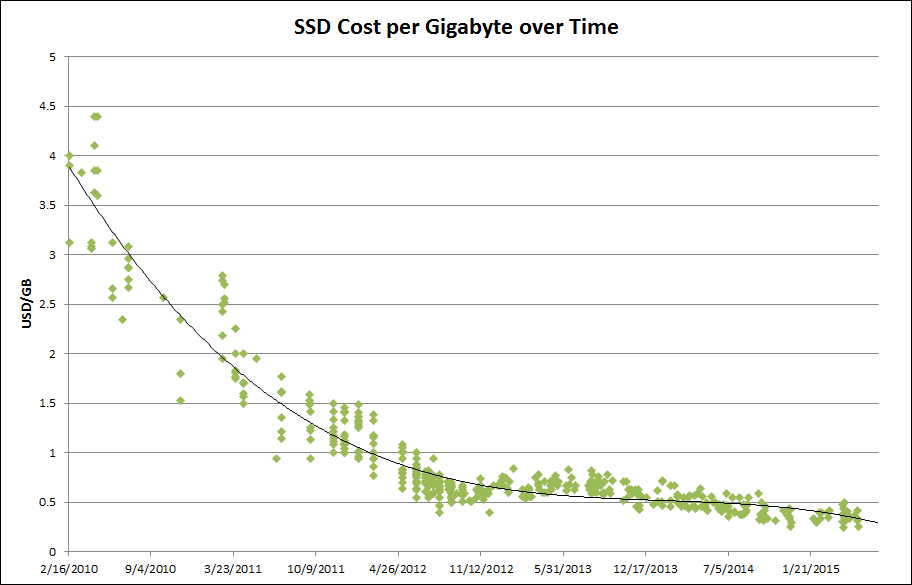
The author commented that they've seen a 50% drop in price over the last 8 months (from 20x HDD to 10x HDD), so it's not outside the realms of probability with the increased yields of 3D NAND.
Just as a test: I looked at the price history for a random 256GB SSD (from Crucial). The highest price in the last year? $115. The current price? $99. Not nearly a 50% drop.
Now you are just cherry picking to prove a point. In a similar tone checkout the huge drop in prices for the Kingston Digital 240GB SSDNow[1]. It has dropped from about $400 to a mind blowing $78!!
I have been tracking the prices of HDD's for a while now. Although I do agree that HDDs are currently substantially cheaper than SSDs, HDDs have had much less drop in price or increase in capacity compared to the pre flood era. The bigger problem facing HDDs now is that almost all major manufactures are bought up by WD and Seagate and this is starting to show the ill effects of a duopoly. So it remains in their best interest to keep the prices high [2].
"The bigger problem facing HDDs now is that almost all major manufactures are bought up by WD and Seagate and this is starting to show the ill effects of a duopoly. So it remains in their best interest to keep the prices high [2]."
It's not in the HDD manufacturers best interest to keep prices inflated, considering price is one of the 2 big competitive edge HDDs have over SSDs.
What happened during the floods was that WD[0] got lucky - data consumption remained high as ever, and SSDs simply weren't cheap enough at that point to fill the void that the floods left behind.
[0] And to a greater extent, Seagate. From what I remembered their facilities weren't directly affected by the flood, but their supply chains were disrupted.
The price is about the same, as is the performance, but are they still making the MX100? If not, I think the pricing information for it will not be very informative.
While I suspect your original comment is closer to the truth than the article's (as far as price parity goes), picking a single data point doesn't make the point. It's rare for a drive to suddenly drop in price so significantly without manufacturing changes (thusly a new version of the drive). So while you're unlikely to see the same exact drive for 50% less after a year it's entirely plausible to see a different model, similar or more capacity, drop in price.
In late 2013 I bought an 840 Pro 256GB for around $190. Today, I'd be looking at a 512GB 850 Pro for $140, probably $120 on a good sale (like when I bought the 840 Pro).
Its about 40% in a little over a year and a half. Significant, at least. Its at the point where you cannot recommend to anyone to use a mechanical hard drive as an OS volume anymore, at least, at any price.