The problem is that nobody really "knows" what is going on. Climate science is still very much a work in progress. This is the sad truth of the matter.
Trying to figure out whether or not humans are a direct cause of climate change is like trying to figure out if exposure to a certain household product gives you cancer. People get cancer all the time from various sources, and while certain folk can point directly to said chemical being a carcinogen, even if that agreement exists it starts to open up a whole new debate about whether or not there is enough of a link to matter.
From what I can tell, ignoring the single idiots on either side, we've got:
1. A general consensus that the world is warming;
2. A slightly less strong consensus that humans are contributing to this warming;
3. A majority (but not a consensus, IMO) extending that to humans being the most direct and primary cause of warming;
4. A strong consensus that we should reduce our overall carbon emissions (for obvious reasons), regardless;
5. A small but significant scientific group arguing that we are not the primary cause of warming, even though we may be a contributing factor;
6. A large contingent of non-science laymen that feel that because 5 may be a valid opinion, the entire study of climate science is bunk;
That's basically the best I've found. There are zealots in every camp above. There are also those that feel that each individual point being right means we should either ignore everything else, be it science or consequence.
Given how complex the earth's climate is, and how little we know about things like the sun, earth's climate history, and the long term effects of particular chemical compositions in our atmosphere, I feel we won't progress much past our current stage in enough time to make much a difference overall. IMHO, if we believe that climate change is real, we should be focusing all efforts on dealing with it as best we can.
> 3. A majority (but not a consensus, IMO) extending that to humans being the most direct and primary cause of warming;
That's just flat out wrong. There is a scientific consensus that humans are responsible for global warming. To elaborate: "That humans are causing global warming is the position of the Academies of Science from 19 countries plus many scientific organizations that study climate science. More specifically, around 95% of active climate researchers actively publishing climate papers endorse the consensus position." [0]
This is based on models that have been refined over decades, and data and analysis from multiple separate scientific disciplines that agree with each other.
Your resignation that we don't 'know' (which alludes to an unscientific requirement for 100% certainty), and that climate science is 'still very much a work in progress' betrays a lack of knowledge about scientific models in general. It is worth reading this section on climate models to understand their purpose, value, and reliability [1].
This is a tired, erroneous argument which surprisingly still gets dragged out, and was commented on back in 2004 [0]:
"The skeptic attitude to consensus usually starts with “there is no consensus”. That’s wrong, and they usually retreat from it to “but consensus science is meaningless”, and/or “consensus has nothing to do with science”. The latter is largely true but irrelevant. The existence of the consensus doesn’t do a lot to determine what science is done; it doesn’t prevent contrary lines being explored. But the consensus view does come into the tricky interface between science and policy, and science and the media."
There are five seperate studies on the image, and most of them show no more than 85% give or take. If you have something that shows otherwise (aside from ad hominem) I'd love to see it.
An uploaded image to Wikipedia is a very weak source to assert an opinion not held by the scientific community (that there is no scientific consensus).
Also, I've been discussing the arguments all along, not sure what the reference to 'ad hominem' is about.
It mentions: "No scientific body of national or international standing has maintained a dissenting opinion; the last was the American Association of Petroleum Geologists, which in 2007 updated its 1999 statement rejecting the likelihood of human influence on recent climate with its current non-committal position."
Maybe the American Association of Petroleum Geologists made that image you reference before changing their position. I don't know, it's completely out of context.
There is also a bit of echo chamber, the high numbers are for "Most Published" authors - and, in theory, it's a lot easier to publish something supporting Global Warming right now.
I'd agree- significant majority, but not a consensus right now.
In terms of its contribution to global warming Methane is 26 times more destructive than CO2. Believe it or not on a daily basis an average Cow emits the same amount of green house pollutants that contribute to Global Warming as an average car. US Food and Agricultural Organization expects methane emissions to increase 60% by 2030.
I understand the logic but I find it counter-intuitive that pollutants emitted from Cows (burps and farts), are contributed to human behavior. Specifically, Agriculture accounts for 14% of Green House Gas, and a majority of it is from Methane emission. Similar to our trying to reduce CO2 emissions from cars, humans are trying to reduce Methane emissions from Cows including genetic modifications and harvesting the Methane to power the farms.
So I personally think the idea of measuring "human contribution" is complex, especially when Cow farts and burbs are contributed to human activity. That said whether or not there is consensus that Human activity is responsible for global warming it does not matter, there is certainly consensus that Human's are the only ones who have a chance at addressing global warming, unless unknown to us the Cows are currently convening in secrete meetings to discuss how they might better regulate their own emissions of Methane and Ammonia because their contribution to global warming is weighing so heavy on their conscience.
Most cow flatulence is the result of human activity. Before cows were domesticated, there was almost no chance cows would ever reach these ridiculous herd sizes in nature (barring natural selection for KILLER COWS).
Also, they did not eat corn or soy-based diets much in nature, which both cause increased methane emissions. Alfalfa and flaxseed are proven to reduce emissions.
The vast majority of cows exist only to feed humans. Saying that pollutants emitted from cows shouldn't be attributed to human behavior is like saying that pollutants emitted from cars shouldn't be attributed to human behavior: complete nonsense.
To give credence to the notion that "cow methane is not humans' fault" is also utterly disingenuous. "ultimately our doing" also suggests there is a long and arduous causality chain which equally absurd. Humans raise cows on diets cows would not choose for themselves (and resulting in more cow methane) and in numbers that the cows would not be able to maintain on their own. Cow methane is our fault in the exact same way that burning stuff and releasing CO2 is our fault. Seriously are you going to say burning coal is not a human source of methane, or at least sit around and say "be nice to the idiot arguing it?"
Sorry, your whole point is more intellectually dishonest than you accuse the "complete nonsense" phrase of being.
But for humans coal plants and their emissions would not exist. But for Humans cars and their emissions would not exist. But for Humans a population of 60 million American wild Buffalo might still exist.
I did not post to be controversial, I was not suggesting humans are not responsible for Global Warming, however, the contribution of humans to global warming is not always black and white. Cars and coal plants? Yes, black and white humans are responsible. Cows? Yes and No, sure you can count the 1.5 billion domesticated cattle as human behavior, but on the other hand 20% of all cattle are found in India where they are not domesticated or raised to be eaten. However, I suppose it is a matter of time before someone makes an analogous argument to the agricultural argument, if you can argue Humans raise cows to be feed on therefore their pollution is attributed to humans, then you can argue that if Humans raise cows to be worshiped their emissions are still attributable to humans....Screw it....whether you drive a car, operate a coal factory, spray an areosol can, eat a steak or passively worship cows you are 100% responsible for global warming.
> This is based on models that have been refined over decades, and data and analysis from multiple separate scientific disciplines that agree with each other.
Models on decades when considering climate change are meaningless: we are talking about extrapolation, going into a warmer world for which we have no models working so far. Beyond that point it's just supposition.
> climate science is 'still very much a work in progress'
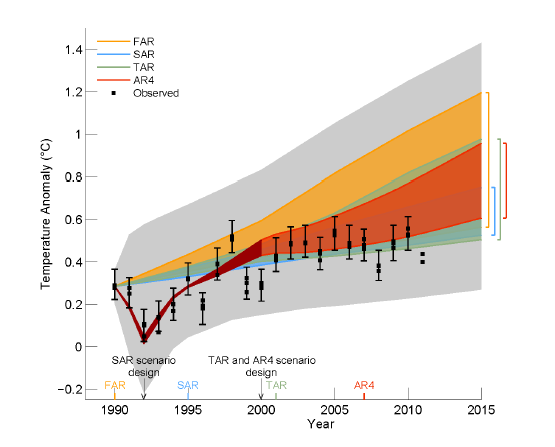
It is very much a work in progress, since there are clear setbacks from the reality vs what has been predicted so far.
The recent CERN CLOUD experiments results show that many climate scientists seem to forget that there's a huge fireball in the skies that may also have an impact on our climate. It's not all about CO2.
Your post is unsupported by evidence, and seems to be just lazily taking the middle road in an attempted to appear enlightened. The two sides of the "debate" are not equal. There is not substantial disagreement that the climate is changing and that humans are directly responsible.
Also note that while his post might be unsupported by evidence that doesn't make it stick out in this debate.
Stating that 'The two sides of the "debate" are not equal. There is not substantial disagreement ... that humans are directly responsible ' is trying to bully someone into accepting your idea of the world and is what politicians do at TV not what engineers and scientists are supposed to do.
(Contents behind link: The amount of ice on Greenland have seen significant variations over the last few hundred years, even before we started using fossil fuels.)
(Personally I'm all for reducing the use of fossil fuels but my _biggest_ reason is because they are a very finite resource and seem to be running out during our lifetime at the current rate of consumption.)
>The amount of ice on Greenland have seen significant variations over the last few hundred years
Yes, because of well known past climatic variations (some of which were probably localised). There are other drivers of climate than carbon emissions, and these drivers have caused climate to change in the past. That doesn't mean carbon emissions can't drive climate today. We can measure many of these other drivers, and we can see that changing solar output for example can't be driving the current warming.
If I read your argument correctly, it seems you think this argument weakens the case for climate change. I think there's a danger in this method of trying to second guess science. I see a lot of the same form of argument from evolution deniers, too, and I always find it hard to understand. The point seems to be: here is a surprising fact that suddenly makes science less sure than you might have been led to think.
The problem with it is that scientists see the exact same evidence as you do, and of course have already taken it into account. The whole point of science is to rake in as much evidence as possible and include it in the calculations.
Those figures mentioned upthread, for scientist consensus on climate change? That's including facts like this, not ignoring them.
On the other hand I'm feeling that way too many take this debate to a level where they actively deny any evidence that points towards a different solution.
Try to find where this was considered. I haven't heard a good explanation yet.
Science is not fixed. A long time ago there was a long standing agreement that the sun and other planets were orbiting around the Earth, and they had complex models (Ptolemean ones) to calculate their trajectories, and that was reasonnably working well until humanity was able to get much more precise tools to measure the planets position and found inconsistencies.
The History of Science is full of such "largely admitted theories" that fell flat when new data, new methods were introduced.
What may seem "obvious" to a group of scientists now, even if they constitute 90% of the voices out there, may not be the actual truth.
I am not saying who is right or who is wrong, but even if you had a consensus, it would not mean that they get it right. We are ever learning.
Your point doesn't have a point. If the question is "is there global warming, and are human beings substantially responsible?", the answer is "yes". You're saying "but it could always be no".
The answer is "yes", and some point past that is where the discussion currently exists.
Maybe you did not get what I mean.
I am saying there is no such thing as Scientific certitude just on the basis of people agreeing with each other. Scientific certitude is driven by an explanation of what is actually occuring, experimentation and reproduction of experiments. There is no way to "experiment" with Climate Change therefore all your models are just models and cannot be proved by experimentation. They are just theories, like Einstein's theory of relativity, which took a long time to be actually proven by experimental data.
The downer of having only one Earth to work with is that you have only one Earth to work with.
Models, measurements, their comparisons to expected outcomes are all that we've got in this particular scientific department. The "experiment" is comparing your best model with what happened before and what happens next, not with running the same thing a thousand times.
As I mentioned in another post, a "model" only works within its known limits. If the Earth is getting warmer outside of the limits of the established model, your model is not valid anymore. You know the xkcd joke about extrapolation, I guess?
I remember Al Gore showing the level of CO2 increase by jumping on an elevator and saying "imagine how much this increase will bring the temperature up!". But truth is, we don't know, nobody knows how much it will increase. There is no model data for that.
It's incredibly depressing to me that this vague and uninformative comment is now rated higher than actual links to actual scientific resources on the topic.
To be honest, what I find depressing is that you figure my neutral assessment of the overall state of climate science should somehow also include a rebuke of that minority in the way a religious person talks about how other religions are "misguided".
Scientific opinion should always - always be encouraged. This is part of what is supposed to separate science from religion. No major leap forward in our understanding has every been provided by the consensus.
The top-level post asked specifically for books, and more generally for reliable scientific information. It did not ask for random people to share their own opinions on the subject.
> Scientific opinion should always - always be encouraged.
Scientific research should always be encouraged. Anyone can hold an opinion.
And such books don't exist, specifically for the reasons I mentioned. That's the reason I said it.
Seems to me the only people getting upset about my comment are people that want the matter closed. That's bad science. This isn't a fox news program where loonies are "valid opinions".
A "Scientific Opinion" is an opinion based on research.
You are suggesting that research that leads to alternate conclusions should be stifled, which is precisely the problem with your line of thinking.
Fact: CO2 traps heat.
Fact: CO2, which was pulled in by plants and processed into hydrocarbons and was buried in the earth for millions of years, is now being reinjected by use of said hydrocarbons for energy back into the atmosphere after a millions years long abscence.
Fact: This is causing a measurable increase in PPM concentrations of CO2.
I think its pretty fucking logical that this would cause or contribute to warming. Obviously figuring out the magnitude is difficult.
I'm on neither side of the debate but I can tell you that saying stuff like "I think its pretty fucking logical" automatically puts you in the zealots category. I would advise you not to use such emotionally charged language if you want to get your point across, especially not on HN.
Zealots? I wouldn't say that, considering that I don't even think that reduction of CO2 emissions on a global scale is a realistic solution. The zealots tend to stick with that one though. I'm actually wishing for a debate on the best way to deal with rapid increases of CO2 concentrations, either through reduction or geo-engineering solutions.
BTW, calling it a "debate" pretty much automatically puts you in a category also. The only reason it's even put into the public's mind as a debate is because of the huge business interests which are threatened by the science. You might as well say that you aren't on either side of the "cigarettes cause lung cancer" debate. Do you think Exxon is going to do anything different than R.J. Reynolds and Phillip Morris did when they spent decades challenging the science of tobacco induced cancers?
I am all for questioning and challenging the science WITH SCIENCE, as opposed to economic arguments and ad hominem attacks.
Your use of the emotive word 'fucking' in this context is suggestive of a zealot but you confirm with your second paragraph above. Crystal clear that you simply have not read any of the recent peer-reviewed literature relating to climate. If you want to comment on this subject in public, get informed first. Once you have done so your comments will be a good deal more nuanced.
My use of the word 'fucking' was more of a casual, matter of fact nature, If this was verbal, it would be a soft spoken, rather than a shouted expletive. But to be fair, use of foul language clearly diminishes any written statement.
Your commment indicates that something I said has been contradicted in recent peer reviewed research. However, your statement is completely nebulous. What peer-reviewed research? What points in my statements prove I'm not aware of said research? Can you elaborate, or perhaps provide a link to said study? I am always interested in learning more facts about this topic.
I'm not really paying much attention to this thread, but I kind of skimmed over your comment when you started with the foul language as well. At the very least, it doesn't win you any points, and at worst, people ignore what you write.
Obviously figuring out the magnitude is difficult.
In other words, you are punting at precisely the critical point in the analysis.
Fact: If you just calculate the effect of CO2 on its own, it's too small to be significant. To make CO2 significant, you have to assume large positive feedbacks elsewhere in the system that amplify the effect of CO2. That assumption has not been validated.
I find it interesting that this is the only post out of 190 or so that mentions what the actual debate is about.
There are very few authorities who flatly deny the planet has warmed a degree or so over the last 100 years. There are very few authorities that deny that man is the most likely cause of this warming. And yet, nearly every post in this whole thread is essentially debating how moronic, on a scale of 1-10, those "climate deniers" are.
I find this even more fascinating from a place like HN, where the users are generally very intelligent and often have some science education. It's ironic that the users ranting against these uneducated people who don't believe in climate change are exhibiting the very same sort of ignorance they decry: they've accepted the media's characterization of the debate.
To clarify: those in the Al Gore camp calling for drastic reductions of CO2 are essentially asking the third world to remain poor, and are asking the first world to become a little less rich. Their justification is that there will be catastrophic results unless emissions are immediately curbed. The reasoned opposition is not that humans cannot affect the atmosphere, or that warming hasn't happened. The argument is that the hypothesized positive feedback loops that make the models predict catastrophic warming are wrong. Interestingly, many scientists have continued to lower their forecasts for just how sensitive the climate is (See http://dotearth.blogs.nytimes.com/2013/02/04/a-closer-look-a..., for an example in the news just today).
those in the Al Gore camp calling for drastic reductions of CO2 are essentially asking the third world to remain poor, and are asking the first world to become a little less rich
To clarify the clarification a bit further: those in the Al Gore camp are asking most people in the first world to become less rich, but that's mainly because some (like Gore himself) stand to make quite a bit of money by using "carbon credits", cap and trade, etc. to siphon wealth from other people's pockets into their own. That's a key reason to oppose such centralized schemes: even if there is a real problem, it won't get fixed that way, because any expected benefits will be more than swallowed up by the social costs of people gaming the system.
> some (like Gore himself) stand to make quite a bit of money
> That's a key reason to oppose such centralized schemes: ... any expected benefits will be more than swallowed up by the social costs of people gaming the system.
Wait, what? I'm not sure I've understood this allegation here, or that I have all the facts, so please correct me if/where I'm missing something. With that in mind, here's what I know.
With respect to solutions, I think you're saying that "centralized" incentives are a bad idea because they can be gamed (to various degrees). Suppose with me (just for this paragraph) that there is a catastrophic problem looming. What alternatives are there to centralized schemes, whether absolute restrictions, or capitalist incentives? Are you hoping that everyone will spontaneously change their behaviour? If that's what you're proposing, I disagree violently. If you have some other proposal (other than centralized planning, and other than spontaneous distributed action), I'm curious what it is.
With respect to Al Gore in particular, I think you're claiming that Al Gore's bona fides as an objective judge are compromised by his profit opportunity. All I'm aware of is that he is a partner at KP, which is invested in greentech, where he has forfeited his salary. He presumably has some equity there (not known to be forfeited), so I guess he might profit some if centralized schemes are implemented. But it strikes me as downright crazy reasoning to assume that because he has allocated (some of) his personal wealth to a capitalist solution (in the capitalist country that he is loyal to) to a problem he's worried about, that therefore he's not _sincerely_ worried about the problem.
If there is a catastrophic problem looming, and we can't adapt, we're probably screwed. I agree people aren't likely to spontaneously change their behavior just because someone tells them there is a catastrophic problem looming; they will need much harder evidence than that, and on the hypothesis that there is a catastrophic problem looming, by the time there is hard evidence it will probably be too late.
However, that doesn't make centralized schemes look any better, because on the hypothesis that there is a catastrophic problem looming, the schemes will have to be so drastic and so draconian that to say they will be gamed is a massive understatement. The sorts of relatively mild things that are being proposed, like a carbon tax or cap and trade schemes, won't stop a catastrophic problem. We would have to massively re-engineer the world's entire economy. And nobody knows how to do that, so even if we tried a centralized scheme, it wouldn't work; we'd be at least as badly off as if we'd hoped people would spontaneously change their behavior.
(The above is all irrelevant anyway, because we already know we can't re-engineer the world's entire economy; China and India and the rest of the developing world won't let us.)
If there is a catastrophic problem looming, the best we can do is to try to figure out how to adapt. If sea levels are going to rise, build levees. If agriculture is going to have to shift to different areas of land, work on how best to shift it. Or figure out how to induce cooling to offset the warming--for example, by pumping aerosols into the upper atmosphere to simulate a volcanic eruption, since those are known to have a cooling effect. (To me, trying to induce cooling is more risky than adapting, because I'm not convinced we understand the climate well enough to predict the effects. But since we do have past data on volcanic eruptions, we can at least use that as a benchmark if we were desperate enough to try such a scheme.)
I think you're claiming that Al Gore's bona fides as an objective judge are compromised by his profit opportunity
That's certainly not the only reason I think Al Gore isn't an objective judge. I just point it out as an example of the sorts of conflicting interests that are in play in any centralized scheme.
As far as Gore being sincerely worried about the problem, I think he is, but it's hard to be sure, just as it's hard to be sure with any politician. In any case, whether or not his worry is sincere is irrelevant; people can be perfectly sincere and still game the system, because they don't see what they're doing as gaming the system. The very fact that their beliefs are sincere makes it harder for them to do that; they think their beliefs are just reality, since that's how sincere beliefs present themselves to the human mind, so they don't even bother exercising critical thinking about them.
It's question-begging to say "If there is a catastrophic problem looming, and we can't adapt, we're probably screwed." Well, duh. But -- since my thesis is that your apparent principled derision for centralized solutions is misplaced and self-defeating -- I'm interested in the case where there is a catastrophe looming, and there are things that humanity collectively can do about it. (I'm especially interested because I think there's a good change that GCW may be such a case, although I don't know.) You formulated what appeared to be an attack on "the Al Gore camp" that depended for its plausibility on an a-priori dismissal of centralized solutions, and that's what I wish to dispute.
"[If] there is a catastrophic problem looming, the schemes will have to be so drastic and so draconian" Citation needed. I claim that there is no reason to believe that moderate action, taken collectively, cannot meaningfully improve our long-term outcomes. In fact, as a general rule of thumb, for arbitrary problems, I tend to assume that results generally improve monotonically with (productive) effort taken, although usually not linearly (and admittedly not ALWAYS monotonic). If the no-coordinated-action-taken path is ten feet of sea level rise, maybe with reasonable coordinated action we can limit it to 9. Or 1. Maybe with draconian and drastic coordinated action we can limit it to 5 or 0 respectively. If the no-coordinated-action-taken path is ecocide, maybe drastic action would be required to maintain our standard of living, but moderate coordinated action could improve from "ecocide" to "many disasters". In any of these cases, people gaming the system is a source of friction, and we should resist that, but not at the expense of tackling the problem!
So, then, usually coordination on things like environmental change requires a certain amount of majority-rules coercion. Libertarians might think it's better to die free, but most people seem to agree that sometimes this sort of coercion is worthwhile (but surely not for every little thing!). So reasonable people are left without the solace of blanket statements like opposing all centralized schemes without a cost-benefit analysis.
"That's certainly not the only reason I think Al Gore isn't an objective judge"
I didn't say it was the only reason, I said you made that attack. I think the context in which you made it makes it look like Al Gore is markedly unworthy of the trust we might place in a randomly-selected human (that is, I think you're proposing that we have extra reasons to mistrust him). I think that the very evidence of his investment is, in fact, a reason to trust him slightly MORE than a randomly-selected human.
And the (purported) conflict of interest (singular) that you point out is not a conflict of interest in a centralized scheme. That's completely missing the point. Even if people take action collectively, without any centralized incentive structure, green companies will profit. So arguments about gaming the system are generally not arguments against centralized action. People are taking decentralized action doing things like buying carbon credits for airplane flights. You think that's not being gamed? The question is how to take effective action, and then to coordinate people to take that effective action together.
"If there is a catastrophic problem looming, the best we can do is to try to figure out how to adapt."
That might be true, but it's not at all clear.
If there is a catastrophic problem looming, the best we can do is
* understand the scope of the problem, and the true cost to us
* understand what levers will move the problem
* make cost/benefit analyses of which levers we should move, and how hard
* coordinate people to take action, and hopefully share the cost somewhat "equitably" (including figuring out what that means)
Let me acknowledge that a large part of the cost to us is really "lose lives", "lose cities", "lose agricultural land", and thus "build levees, shift farms, etc" MIGHT be the most effective solutions. But I think that it's hard to imagine how high those costs will be.
(Especially considering that we're all gonna hafta get off the oil soon anyway, when it runs out.)
since my thesis is that your apparent principled derision for centralized solutions is misplaced and self-defeating -- I'm interested in the case where there is a catastrophe looming, and there are things that humanity collectively can do about it
Saying that there are things humanity could collectively do in theory is not the same as saying that centralized "solutions" will actually achieve those things. To do that, we have to actually know the right solution; we have to have enough understanding of the problem domain to be able to make accurate predictions of the effects of our actions. We don't have that knowledge in the case of climate change; indeed, we don't have it in most areas in which we currently force collective action on people.
Take the recent mortgage bubble as an example. This was the result of a centralized "solution" to the "problem" of not enough people owning their homes. The result was to create a new way for people to game the system that ended up tanking the entire economy, and now all those additional people who were supposed to own their homes are being foreclosed on and evicted.
In short, you appear to have a lot more faith in centralized solutions than I do. I would have thought that the twentieth century, if it showed anything, would have showed that centralized control doesn't work--after all, the Soviet Union was a 70-plus year experiment demonstrating that.
I think that the very evidence of his investment is, in fact, a reason to trust him slightly MORE than a randomly-selected human.
Let's translate this into another domain: the very evidence of Wall Street's investment in mortgage securities is a reason to trust them more than a randomly-selected human. Does it still seem reasonable?
Even if people take action collectively, without any centralized incentive structure, green companies will profit.
Why? Because they're actually solving a problem, or because they're gaming the system? You admit carbon credits are being gamed. Al Gore is therefore one of the gamers. How is that supposed to increase my confidence in him?
(Especially considering that we're all gonna hafta get off the oil soon anyway, when it runs out.)
I should note that, as I've posted elsewhere in this thread, I agree there are good reasons to reduce fossil fuel consumption that are independent of the climate change issue. (Among them are national security and foreign policy: as I've noted in other posts, if we were smart we would have made eliminating our dependence on foreign oil a national priority in the 1970's.)
they've accepted the media's characterization of the debate
It's not just the media's characterization; it's the characterization of mainstream climate science. They are equating any opposition to the "consensus" to being a "denier". There are lots of positions in between.
It's important to emphasize that CO2 is important mainly for its role as the primary forcing: the actual temperature swing it would cause by itself is minimal. It's the feedbacks that kill us (and which are, unfortunately, quite a bit messier than the very clear humankind-CO2-greenhouse effect connection that exists).
You left out 7 (which encompasses a large part of 5 as well): a well-paid contingent of flacks for the fossil fuel industries. Also, the fact that so far, climate change has been more extreme than most projections.
You forgot to mention the well-paid contingent of pro-AGW scientists and bureaucrats whose ability to earn a living largely depends on it being a real and serious issue. There is a natural tendency towards confirmation bias on both sides.
Also, the fact that so far, climate change has been more extreme than most projections.
Actually, warming has not occurred at all in the last 15 years or so. So how "extreme" we've been is a matter of vantage point.
While I'm not in the camp to suggest the last 15 years are anything but a variation in the overall trend, be careful what you use to support dire predictions.
In the 1850-2012 graph the temperature is mostly increasing, but not straightly increasing. The interesting part is the flat part at the end. It is expanded in the 1997-2012 graphic. In this period the temperature anomaly is ~.5C, it is even very slightly decreasing, but it's too noisy to take the decrees seriously.
The graphs are based in the HadCrut data: http://www.metoffice.gov.uk/news/releases/archive/2012/hadcr... compiled by the UK Met Office. I didn't download the data and redraw them, but in that page they have a table of yearly global average temperature of the last ~15 years. The temperature anomaly is ~.5C and the variation of the numbers look similar to the values in the graph.
Ask yourself this question: if there has been no warming, what ratio would you expect between the number of record high temperatures and the number of record low temperatures, and if substantial warming had occurred, what would the ratio be, and what has actually happened. Then consider animal and plant species, their ranges, and migration patterns and dates. And examine what has happedened in those regards. Have you looked at any of these, or are you merely parroting somebody's propaganda?
I personally believe both in anthropic global warming and that we should do something about it, but have no problem with the grandparent post's observation about the existence of some scientific opposition to this point of view. You'll note that the contrarian scientists listed at the link above tend to be relatively qualified to have an opinion by virtue of their academic specialty (as opposed to the opinions of scientists with no particular insight into such matters like, say, metallurgists or linguists). I find such counter-arguments interesting and worthy of consideration even when I don't agree with the conclusions drawn.
Thanks for the link. I looked up the views of the first scientist listed under "Scientists arguing that global warming is primarily caused by natural processes". Here is what I found
"Abdussamatov claims that "global warming results not from the emission of greenhouse gases into the atmosphere, but from an unusually high level of solar radiation and a lengthy—almost throughout the last century—growth in its intensity."[4] This view contradicts the mainstream scientific opinion on climate change as well as accepted reconstructions of solar activity. [5][6][7] He has asserted that "parallel global warmings—observed simultaneously on Mars and on Earth—can only be a straightline consequence of the effect of the one same factor: a long-time change in solar irradiance."[8] This assertion has not been accepted by the broader scientific community, some of whom have stated that "the idea just isn't supported by the theory or by the observations" and that it "doesn't make physical sense."[9][10]
Abdussamatov also contends that the natural greenhouse effect does not exist, stating "Ascribing 'greenhouse' effect properties to the Earth's atmosphere is not scientifically substantiated."[11] He further states that "Heated greenhouse gases, which become lighter as a result of expansion, ascend to the atmosphere only to give the absorbed heat away." He has stated that more work is needed to model the effect. However, this effect cannot happen because the mean free path of molecules in the atmosphere is very short, transferring energy by collisions and preventing greenhouse gases from retaining the excess energy they absorb.
In early 2012, Abdussamatov predicted the onset of a new "mini-iceage" commencing 2014 and becoming most severe around 2055.[12]"
Is this really a a significant contrarian as the OP stated?
Please reread my last sentence above: I don't find the arguments of these skeptics convincing. In several cases I think they're quite wrong. However, I also think they have a decent understanding of the scientific context and that their arguments are quite likely made in all sincerity. The point of the original list was not to validate the position of these scientists, but to observe the fact that there is a small number of scientists who hold those contrarian positions.
Just because I think they're wrong doesn't mean they don't exist or that they're necessarily lying.
I understand what you were saying, but it was said in the context of the first comment I was replying to. There the OP said, "A small but SIGNIFICANT scientific group arguing that we are not the primary cause of warming"
The use of the word 'significant' was a value judgement on the OPs part, and one that I wanted him/her to substantiate. You replied with a link attempting to substantiate that claim, so I replied with that context in mind.
It's significant enough for me that they're practicing academics in a reasonably relevant field who work within the peer review process, as opposed to self-described scientists or the sort of deniers who have no real theory about climate but monger conspiracy theories about mainstream climate scientists, who the OP had put in a different group (#6, I think).
Baliunas is a strong skeptic in regard to there being a connection between CO2 rise and climate change, saying in a 2001 essay with Willie Soon:
But is it possible that the particular temperature increase observed in the last 100 years is the result of carbon dioxide produced by human activities? The scientific evidence clearly indicates that this is not the case... measurements of atmospheric temperatures made by instruments lofted in satellites and balloons show that no warming has occurred in the atmosphere in the last 50 years. This is just the period in which humanmade carbon dioxide has been pouring into the atmosphere and according to the climate studies, the resultant atmospheric warming should be clearly evident.[15]
The claim that atmospheric data showed no warming trend was incorrect, as the published satellite and balloon data at that time showed a warming trend (see satellite temperature record). In later statements Baliunas acknowledged the measured warming in the satellite and balloon records, though she disputed that the observed warming reflected human influence.[16]
Baliunas contends that findings of human influence on climate change are motivated by financial considerations: "If scientists and researchers were coming out releasing reports that global warming has little to do with man, and most to do with just how the planet works, there wouldn't be as much money to study it."[17] [18]
Warning: Wikipedia entries on climate change have become heavily politicized, and entries on individuals are often rewritten to make them look ridiculous. See for instance the media coverage of William Connolley's role at Wikipedia.
I tried editing a few inaccuracies related to a scientific misconduct hearing involving Bjorn Lomborg, and was stunned at the vicious personal attacks I received in response. I gave up on Wikipedia at that point, as have many other moderate, reasonable people.
Good point, and I did look them up in other places. One of them believes there has been significantly more solar activity than is the consensus in that field.
> The problem is that nobody really "knows" what is going on. Climate science is still very much a work in progress. This is the sad truth of the matter.
That's completely irrelevant. If you've read the IPCC bricks, you'd know there is a very sharp line between what's known and what's not and speculating on hidden variables makes no sense at all. But doing nothing or business as usual is not an option, except you pretend to live alone on this planet.


Trying to figure out whether or not humans are a direct cause of climate change is like trying to figure out if exposure to a certain household product gives you cancer. People get cancer all the time from various sources, and while certain folk can point directly to said chemical being a carcinogen, even if that agreement exists it starts to open up a whole new debate about whether or not there is enough of a link to matter.
From what I can tell, ignoring the single idiots on either side, we've got:
1. A general consensus that the world is warming;
2. A slightly less strong consensus that humans are contributing to this warming;
3. A majority (but not a consensus, IMO) extending that to humans being the most direct and primary cause of warming;
4. A strong consensus that we should reduce our overall carbon emissions (for obvious reasons), regardless;
5. A small but significant scientific group arguing that we are not the primary cause of warming, even though we may be a contributing factor;
6. A large contingent of non-science laymen that feel that because 5 may be a valid opinion, the entire study of climate science is bunk;
That's basically the best I've found. There are zealots in every camp above. There are also those that feel that each individual point being right means we should either ignore everything else, be it science or consequence.
Given how complex the earth's climate is, and how little we know about things like the sun, earth's climate history, and the long term effects of particular chemical compositions in our atmosphere, I feel we won't progress much past our current stage in enough time to make much a difference overall. IMHO, if we believe that climate change is real, we should be focusing all efforts on dealing with it as best we can.