Anecdotally, both from riding in them and walking/driving next to/around them, this feels obvious. They never get distracted. Sure, they sometimes make mistakes, but the mistakes are never "I didn't see that". They see better than humans in all cases (where they operate). They react faster than humans.
The one case where they hit a child, it was because the child jumped in front of the car. And they showed that they hit the child at a lower speed than a human would have because of the reaction time.
I would rather be in an area where only Waymo's are allowed than an area where they are banned.
When I visited LA, I rode in a Waymo going the speed limit in the right lane on a very busy street. The Waymo approached an intersection where it had the right of way, when suddenly a car ignored its stop sign and drove into the road.
In less than a second, the Waymo moved into the left lane and kept going. I didn't even realize what was happening until after it was over.
Most human drivers would've t-boned the car at 50+ km/h. Maybe they would've braked and reduced the impact, which would be the right move. A human swerving probably would've overshot into oncoming traffic. Only a robot could've safely swerved into another lane and avoid the crash entirely.
Unfortunately, the Waymo only supported Spotify and did not work with my YouTube Music subscription, so I was listening to an advertisement at the time of my near-death experience. 4.5 stars overall.
> Unfortunately, the Waymo only supported Spotify and did not work with my YouTube Music subscription, so I was listening to an advertisement at the time of my near-death experience. 4.5 stars overall.
This detail sent me, it's crazy that we can pay $25 to have a life saving robot take us across the city yet Spotify is going to blast ads at us the whole time for the sake of making an extra $0.18 (yes that's the actual number) per hour of listening time.
That's around 44.64 (0.18831) per month, no wonder ads are preferrable to companies over subscriptions! That's actually a lot for people that listen to music all day every day at work.
Google was famously really resistant to ads at first. They wanted to do a subscription service of some kind, but honestly ads just brought in so much more revenue even back then that it was a nigh-inevitable decision. It produces a crazy amount of economy.
> it's crazy that we can pay $25 to have a life saving robot take us across the city yet Spotify is going to blast ads at us the whole time for the sake of making an extra $0.18 (yes that's the actual number) per hour of listening time.
Oh, the self driving car business will get there, believe me. This is just the first iteration. Designed to get everybody on board with the idea.
I wonder if Waymo gets a cut. I also wonder if riding in a Waymo at the time signals that you're in a demographic that can afford a Waymo and thus get more expensive ads.
> I was listening to an advertisement at the time of my near-death experience.
You'll probably never forget that advertisement, which is an exciting business opportunity for Waymo.
They could partner with Spotify and other media content partners so that the Waymo can generate an adrenaline-rush near crash experience when a premium advertiser's ad is playing. /s (hopefully)
This is one of those comments that made me laugh nervously. It's straight out of Ubik or another PKD novel, which probably means it's less than 5 years away from being real.
How ironic that an Alphabet company, Waymo, only works with a competitor streaming music service, Spotify, and not their own, YouTube Music. I guess that shows how separate they are.
I think it's also a privacy thing; you have to go into the Waymo app and “connect” your YouTube Music account (even though both have the same @gmail.com address), because otherwise the terms of service of one do not allow sharing data with the other without user consent. (Contrary to popular perception Google is very finicky about privacy, at least privacy as defined as conforming to the terms of service.)
Because those are the same games I have available while not in a Waymo and I can play them anytime/anywhere. By having Waymo exclusive games that save state between rides that aren't available outside the Waymo, it builds the "only in Waymo" excitement.
That's good news, if I can't use the Youtube Music I've paid for in the Waymo then I'm not going to put up with Spotify Ads instead, better to sit in silence (or use my headphones and my own music)
Yeah I have done similar evasive maneuvers a bunch of times. Also people run stop signs constantly, a competent defensively driving human may have just not started driving forward yet when they saw the other car driving towards the stop sign with some speed. I’m not sure of the exact timing in the story but I’ve waited at a stop sign when I saw another car driving towards the intersection many, many times, and a small percent of the time they don’t stop.
Which isn’t to say that the average driver wouldn’t have hit it, it’s just not obviously superhuman.
In this case, the other car didn't run the stop sign.
It waited at the stop sign like it was making a turn, then suddenly entered the intersection when the Waymo was 5-10 meters away, despite not having the right of way.
Maybe they were trying to commit suicide-by-Waymo?
Thankfully they've now shipped their own product, YouTube Music.
And Google Pay, imagine my surprise back in 2021 when I signed up for Waymo and realized I had to manually type in my credit card. No Google Pay??? C'mon y'all, you're Alphabet!
Next thing you know, they're going to add Alexa support before Assistant/Gemini. The PMs at Alphabet are famously incompetent. Another example from the archives: Google wrote the original official Twitter app for Android instead of letting Twitter do it themselves. It wasn't to help the Android platform because multiple third party Twitter apps for Android already existed.
Its is corporate fiefdom. Everybody trying to one up other executives to show impact instead of working together towards a unified goal. The bigger the company the more we see this phenomena. Nobody gets promotion if you just used existing internal service.
I can almost guarantee, given the way no traffic laws are enforced anymore in LA and so many cars are breaking them that cutting off a waymo car in dangerous ways, because you know it has the attention and reflexes to yeild, will be a new thing.
If it becomes a new thing, it would be fairly trivial for Waymo to respond by sending footage of incidents involving reckless driving to local authorities.
To prevent over-reporting, they could even make a system which logs number plates and only reports it if (for example) the same car is involved in incidents 3+ times in a week.
Waymo supporting music services at all is stupid to me. They should just let you bluetooth your phone and play your own music. I don't want any of those services. I want my own music.
There is a large group of people (maybe even the majority?) who, as soon as they get in a car, MUST immediately turn on the radio or some kind of extra noise source. Is this some kind of a Pavlovian reflex?
I'm always amazed by this, as my car is one of the few places where I have actual control over my environment (unlike on public transport, or at my workplace, or even in my home - neighbours can be noisy...). We are living in a sea of unwanted noise, bombarded by constant ads and "music", so it is nice to have a place of "quiet".
There are even people who listen to music at home! They even buy expensive speakers just for this purpose =) I listen to music pretty much all the time except when I talk to other people and sleep.
Nearly got T-boned in a Lyft in LA. I am lucky to still be alive as the driver was not aware and should not have been driving. Where available I've stopped using human driven rideshare.
I think you're over-playing how decisively a Waymo will move and under-playing how decent the average human is.
I've ridden in Waymos. They don't exactly slap on the blinker and move at the limit of traction like someone about to miss their exit. If cut off they absolutely will go full brake rather than perform any sort of spicy lane change or turn.
> If cut off they absolutely will go full brake rather than perform any sort of spicy lane change or turn.
Essentially, a meat driver was waiting at a stop sign to make a turn onto the main road. I was in a Waymo driving on the main road and did not have a stop sign.
When we were 10 meters away from the intersection, the meat driver suddenly started to enter the intersection. I have no idea why.
Full brake would've hit the other car in the driver's side door at 40 km/h.
> under-playing how decent the average human is.
I got to SMFC in CSGO which means I'm in the top 3% of players in clicking on heads within 500 ms of them appearing on my screen. I have never reacted as fast as that Waymo did.
If instant (<50ms) reaction would have lowered the speed only to 40km/h in 10m, Waymo was going too fast for the intersection IMO.
My experience is that for a human driver to react quickly in city driving conditions, style and prep are more important than reaction time: in the case you describe (entering an intersection with another car waiting on a stop sign perpendicular to your path), I'd have my foot hanging over the brake and off the gas pedal — this has helped me avoid hitting many other cars with inattentive/distracted/bad drivers, and even pedestrians running over the road or a red light on a crosswalk. When you are prepared and looking, you slam the brakes much faster!
>Waymo was going too fast for the intersection IMO.
This is literally impossible without slowing to single digit speeds for every intersections. At some point you just have to rely on the other traffic honoring signaling and signage or having some desire for self preservation.
Waymo uses new cars which probably have 100km/h (62mph) to zero stopping distance around 36m (120ft) — that's what my 2020 car quotes and tests at. As stopping distance grows quadratically, from 50km/h it would have stopped in 8m. Two lane street is usually at least 8m wide.
The claim was that after braking for 10m, it was still going at 40km/h. It'd take another 6-7m to come to a full stop. If it was a full 18m stopping distance (half the one from 100km/h), that'd mean a bit over 70km/h, so over 60km/h anyway for 16-17m.
I do not know of any country where there are intersections you can go through at 60+ km/h legally.
This does not mean that Waymo in question was going too fast, but something is off in the claim (maybe it did not react on time and really brake for 10m; maybe the collision speed was not a full 40km/h; or maybe it was going too fast...).
>I do not know of any country where there are intersections you can go through at 60+ km/h legally.
The US is dotted with "real highways" (i.e. designed as such, not a former main street that's seen a bunch of upgrades) with 50+mph speed limits and low traffic streets that tee into them with nothing more than a stop. And this isn't some middle america thing that can be dismissed as backwards flyover states. The rich coastal states have them too. Divided medians and T-junction type are fairly common. 2-way stops and cross type junctions less so in my experience but in more rural areas they're more common.
>This does not mean that Waymo in question was going too fast, but something is off in the claim (maybe it did not react on time and really brake for 10m; maybe the collision speed was not a full 40km/h; or maybe it was going too fast...).
Seems like someone pulled out from a residential road onto a main road with no f's to give and the waymo went around and OP is messing up the numbers a little. No matter how fast you're going it always feels faster from the passenger seat.
It's a huge difference between someone merging into or crossing a high speed road.
In most of Europe at least (I did not drive enough in States to remember), non-highway intercity roads have a speed limit of around 50-55mph, but where there is any merge or crossing, this is reduced to 30-35mph.
To be honest, I don't know how to convert freedom units to km/h.
I based my estimate on the Waymo going slower than other cars and the city speed limit in Toronto being 50 km/h, and I took a stab at the numbers. I think it was Beverly Blvd which the internet says has a speed limit of 35 mph = 56 kph at the time?
I was in the back seat so I couldn't judge the distance that well. I passed the other car in a second so I guessed that's how much ground I covered.
Understood: I wasn't trying to nitpick the numbers, but simply showing that you were likely crediting Waymo a tad too much for what it has done.
Human drivers correct each others' mistakes every single day, and we don't hear about them because... well, nothing has happened. The argument could be made that Waymos will make fewer mistakes, so fewer evasive maneuvers will be needed, but it's great to hear that Waymo's performance is coming closer to bringing good human driver capability with faster reaction time enabled by tech.
I appreciate you converting to SI units, but I am ok with you keeping them as-is too: either side can do the conversion to whatever they need, and HN is very much a mixed audience.
Pulling out randomly, I see it all the time. I beat the computer by a) anticipating; and b) assuming other drivers are idiots who don't see me. I don't have to calculate trajectories and whatnot, people aren't computers, and they can do some things better than a computer can, especially a solely-reactive one.
To be fair, we are not provided with the sensors to swerve safely.
If we had some sort of 360 constant recording in the car (on screen?) it would be safer for humans to swerve. Instead we have to move our head, which is cheaper but lacks info.
That's why we now have rear cameras
We have rear cameras because people DONT move their head. And because regulations have made cars way taller than they need to be, meaning there is a big blind spot close to the ground
I mean, even in low cars you cannot see a small enough kid walking behind your car. That's why you back slowly.
Back when I just got my driver license, there is a big lesson many drivers go through (in Italy) which is you back off a parking and there is an obstacle that's so low that cannot be see through the back window and it's small enough that cannot be seen through the mirror. You hit it and if you followed the "go slow part" you only damaged the paint.
So I'm not opposing the ideas of rear cameras, but I'm totally against tall cars, because you cannot see kids IN FRONT either now.
Depends on how you define "average driver": what if 95% of the crashes are caused by 5% of the drivers?
My reading of all the human crash stats has been that majority of them happen when human drivers are impaired (drunk, drugged or too tired): as this is something we could (in theory, at least) control, I'd like to see and compare with stats for non-impaired human drivers too.
Then, I'd like to see it compared to attentive, non-distracted drivers too (but we won't have crash data for this, as they would avoid most potential crashes).
Note that I am only talking things under every human driver's control, and not things like skill, reaction time, etc.
Also, modern cars (like Waymos) will have a much lower braking distance compared to "average": eg. my Volvo has 35m braking distance from 100km/h or 62mph compared to 50m (45% more) listed as average (excluding reaction distance) — so from 50km/h, it should be around 8m!
It certainly matters: "average driver" does not exist, and 95% of the drivers beat the average.
So a claim how autonomous driving system beats the average would only tell us that it beats 5% of the human drivers.
Now, the way stats are massaged here is not even about "drivers", but miles driven, and this language is even worse. We'd need to make sure we are looking at human-driven miles in the same area, same roads, with similar cars.
>To be fair, if 5% of drivers cause 95% of crashes then the average driver is still terrible.
>The median one might be better, but does it even matter? The average driver is still wreaking havoc.
Yes it matters. To be acceptable this technology needs to be at least in the same ballpark as a median-ish person on a median-ish day. Not some nonexistent average that is pulled down by the 1/X people who are drunk and the 1/Y who are from Socal and driving in Maine in a blizzard.
The fact that you basically never hear of "average non criminal driver" or "median law abiding driver" and that there is no real attempt at even standardizing a concept of normal drivers not engaged in bad behavior just reeks.
It's like the door is intentionally being left open for the same slight of hand as when people peddle some policy goal having to do with school shootings and back it up with statistics that are mostly normal crime. Or they are peddling some devious tax that will screw a whole lot of people, and they justify it with an average that's dragged way up by a few oddballs, or dragged way down by a bunch of zeros. Seems like the safety crowd and and self-interested industry are setting up to play off each other in a "recyclable plastic" sort of way.
Second off, what are you talking about that the "average driver is wreaking havoc"? The average driver is filing a collision claim every 15-20yr depending on who's numbers you believe. While I don't know the distance between average and median, either is a fairly high bar that Waymo and friends have to meet.
But the point is if we get all the median and better drivers off the road and replace them with autonomous vehicles, yet keep the worst 5% on the roads too, we are potentially worse off.
In Houston the stats suggest that every driver should get into a crash at least once every. But many ppl haven’t been an crash all their lives and more have been in multiple
Great reaction time from the Waymo. But a 50 km/h side impact in a 5 star crash-rated Jaguar with curtain airbags is not "saved my life" territory, more
like an insurance claim. The fact that you instinctively framed it as a near-death experience is Waymo most impressive engineering achievement.
> when suddenly a car ignored its stop sign and drove into the road.
I vaguely recall reading at some point that this is something human drivers learn to do around robot cars because the robots are so timid. Is that still the case, was it never the case, or has it stopped being the case?
If it's still the case, one could argue that if you were not in a robot, the situation would never have occurred in the first place! (On the other hand, if you were both in robots, maybe it also wouldn't have...)
I hope you are misremembering. Swerving is most often the wrong choice, and I would be disappointed if Waymo were opting for that. By far the best option is to panic stop. Human or robot, physics is a harsh mistress and swerving is more likely to make you lose control and end up in a much more unforgiving wreck.
It wasn't possible to stop at the speed the Waymo was moving at.
The Waymo didn't have the stop sign, the other driver did, at a three way intersection.
The other driver decided to suddenly enter the intersection, when the Waymo was like 5-10 meters away. This was after having stopped at the stop sign.
Either they weren't looking or intentionally trying to cause an accident. Swerving prevented the Waymo from crashing at 40 km/h into the driver's door.
This depends a huge amount on car, driver and situation. It was the right advice for a learner driver in the 90s with no stability control, no experience and no side airbags, because if you’re going to hit something, hitting it front on is the least risky way. I’m not convinced it’s the right advice for a competent driver in a modern vehicle.
It is still standard advice today, as far as I know. Tires are better, stability control is better, but all else being equal you are still much more dynamically stable and have a lot more friction with the road when the car is stopping in a straight line than when swerving.
Also, in the case of someone running a stop sign, it is far from a sure bet they are going to hit their brakes at all, so by swerving you increase the odds that you will still hit them, but now it will be while you have exhausted all your adhesion on lateral control. So now instead of a front end collision with all the benefits of airbags and crumple zones, you are at a significant risk of rolling the car or spinning off the road and hitting something immovable with a part of your car lacking crumple zones.
The common mistake is people swerve and brake, which is a terrible combination - you should accelerate through a sudden manoeuvre, as it maintains control through it, much as you should accelerate through corners in general.
Wunibald Kamm begs to differ. For his circle, it doesn't matter if the additional force that causes the friction to be insufficient is forward or backwards on top of the side force. In critical situations either use your friction for lateral xor longitudinal action, never both at the same time. Brake hard, but then sail through the curve. You want that vector to move along the circle and never leave it. As that is very difficult for an untrained driver, better switch hard between both modes.
True if we all drove unicycles - but in the real world, tyre wear is uneven, brake wear is uneven, loading is uneven, the surface is uneven, and those differential forces are what modern ABS seeks to control.
The key difference between braking and accelerating is that in the former case, independent, potentially differentially worn brakes, apply force unevenly, making the chance of a loss of traction on one or more wheels higher. With acceleration, that force is applied through a differential, meaning it will be far more likely to be appropriately distributed.
If you want to decelerate while swerving it can be done, but it should be done through engine braking - and the tricky bit there is matching revs as you drop the clutch back in, otherwise you have too much retarding force and overcome the coefficient of friction, resulting in a skid.
Easier for those of us who grew up with double de-clutching and no synchromeshes, but when you’re in a critical situation, it’s still an awful lot easier to apply acceleration.
Absolutely. I was recently driving on a motorway in Portugal when a boulder (giant chunk of granite, 10+ tonnes) fell off the back of a truck - right in front of us, in a heavily laden (7 pax and luggage) car. Immediate massive cloud of dust, I checked my blind spot, veered across two lanes, and continued our journey, unscathed. I looked in the rear view, to see the car behind us jump on the brakes instead of evading. They caught the boulder.
Nobody killed, according to the news, but several taken to hospital in critical condition.
Oh, I say unscathed but our tyre exploded the next day, as apparently we caught a fragment, and again, that’s not a “slam on the brakes” moment, but rather “trundle to a stop on the shoulder and walk to the conveniently nearby tyre shop”.
In theory, it depends. In practice, slamming on your brakes is the correct call 99% of the time. To a large extent that is because of the "competent driver" part. I'd expect 80%+ of drivers to consider themselves just that, whereas the truth is of course the opposite.
So, the correct advice is to say "brake, don't swerve", so that drivers internalize that their first thought and reaction in any emergency should be to brake. Teach them to actually brake—fully press on the pedal—while you're at it.
A slightly more nuanced advice would be "brake first, swerve as needed as a follow-up".
But I would never in good conscience be able to give anyone advice to swerve instead of braking.
The optimally regulated system doesn't know the road conditions that well. When the road surface is more slippery, it has the most profound effect on lateral friction, way more than braking.
The Waymo driver can measure the speed and the acceleration of the offending car and calculate, within at most tens of ms, its range of likely future trajectories. And it can calculate its own likely trajectories under maximum braking. And it can track exactly where all obstacles are that would matter if it swerves. All at once. And it can execute that emergency lane change with the control input that is least likely to cause a loss of control and most likely to successfully avoid the other car. It even has processing power to spare to keep playing that Spotify ad!
For a human this advice is true. But what if a computer can near-instantly calculate a perfect swerve within the performance envelope of the car and driving conditions?
There are many cases where swerving will avoid an accident that braking cannot and cars unexpectedly pulling out from the side are often among these. It’s not a majority, but it’s not at all rare.
> Waymo saved my life in LA.
When I visited LA, I rode in a Waymo going the speed limit in the right lane on a very busy street. The Waymo approached an intersection where it had the right of way, when suddenly a car ignored its stop sign and drove into the road.
> ...
> Unfortunately, the Waymo only supported Spotify and did not work with my YouTube Music subscription, so I was listening to an advertisement at the time of my near-death experience. 4.5 stars overall.
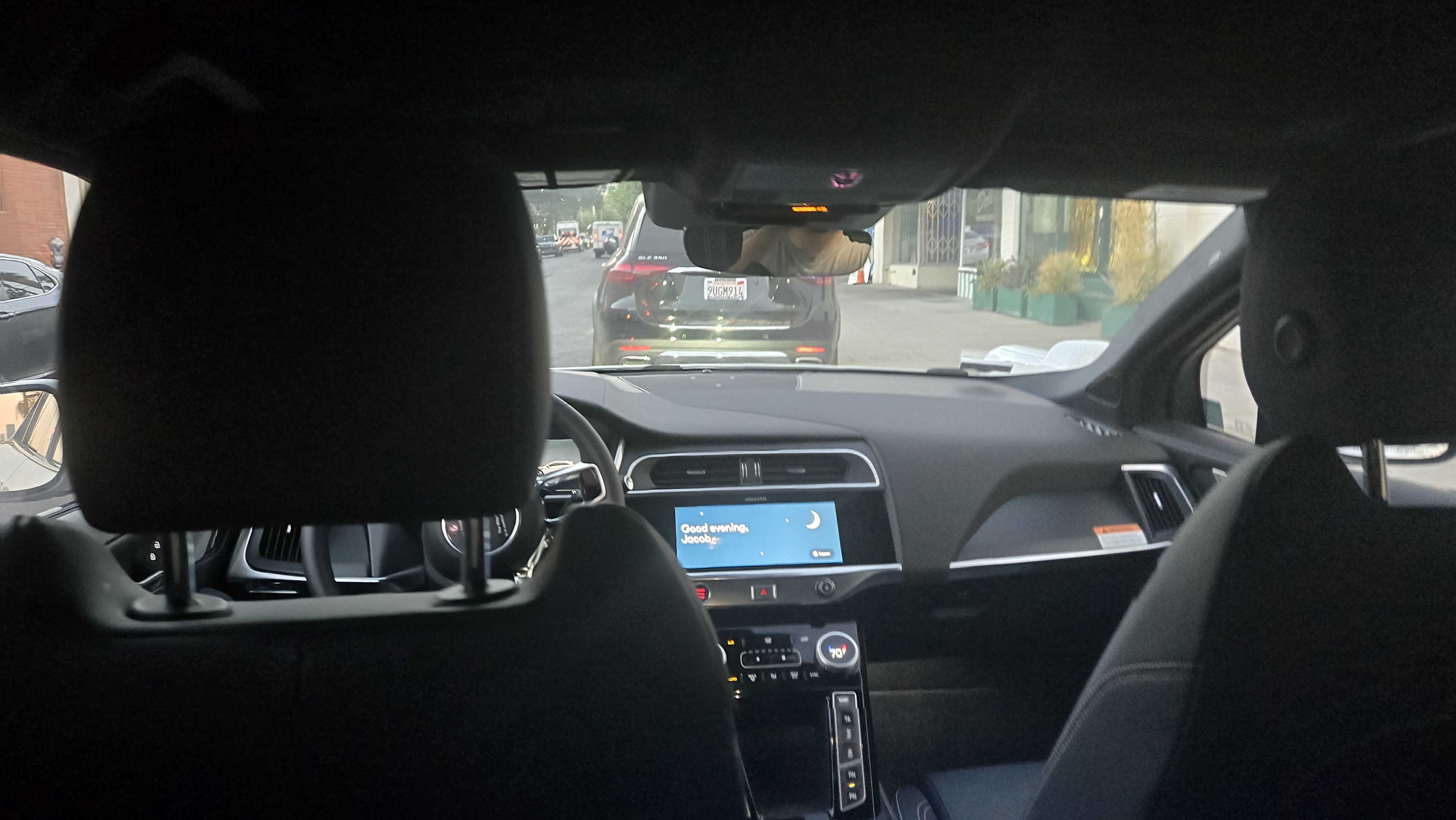
Here is a photo I took inside of the Waymo outside of an Erewhon. Going to Erewhon and experiencing the $20 Hailey Bieber smoothie was on my brother's bucket list and riding in a Waymo was on mine.
He said it was overpriced but bought it again from a different Erewhon so I assumed he liked it (Canadian understatement).
There's apparently a quality gap between locations. The pre-Waymo one was from Erewhon Grove and was freshly blended. Erewhon Beverly Hills on Rodeo Drive premade a bunch of them and left them lying around for a while before selling.
My brother's theory is that Erewhon Grove customers are people who legitimately wanted a smoothie and Erewhon Beverly Hills customers just want photos with the smoothie since it was very popular on Instagram at the time.
Most surprising fact was despite being a licensed product, it was better than the best non-licensed smoothie (coconut cloud).
Licensing deals should make the product worse because the royalties cut into the product margin. The company cuts costs or doesn't take creative risks as a result. But somehow Erewhon resisted these pressures when designing the Hailey Bieber smoothie. We had a discussion about why that was the case but couldn't come up with an answer.
I think they have rotating specials. These are pre-made, cheaper, and smaller. When you have a membership this is the one you get for free (once a month).
They used to have a “Dr. Paul's Raw Animal-Based Smoothie” that I looooved, but unfortunately they stopped making it. Still sad about that one :(
Mixing saving one's life with rating for a drink in the same comment makes feel very weird. Not funny, TBH, but actually it reads like a millions of generated bad review comments on amazon, expedia etc.
Waymo as a system has crossed the threshold where I trust them more than average driver, but all this hardware is relatively new, well maintained, and their software is closely tied to it.
I’m way less confident of self driving in the hands of the general public when differed maintenance often results in people and even companies driving with squealing breaks and balding tires etc.
I am also not looking forward to the system transitioning from "big experiment, burn money to make it good" to "established business unit, tweak it to death for incrementally more money / personal promotion." We're still in the honeymoon period and I very much expect to hate Waymo in 10 or 15 years when they reach a steady state.
What levers are there, really? Waymo has a monopoly and it seems like they will for a while, so they have a lot of power, but all I really see them doing is making it expensive. Anything that makes the experience worse takes away from their ability to take market share away from Uber/Lyft.
Self-driving vehicles need aircraft-type maintenance. Yet there's nothing like the FAA to enforce a minimum equipment list, maintenance intervals, or signoffs by approved mechanics.
Is there a scratch or chip in the scanner dome? Are both the primary and backup steering actuators working? Is there any damage to the vehicle fender sensors? Is dispatch allowed with some redundant components not working? If so, for how long?
Here's the FAA's Minimum Equipment List for single-engine aircraft.[1] For each item, you can see if it has to be working to take off, and, if not, how long is allowed to fix it.
There's nothing like that for self-driving land vehicles.
What's the fleet going to look like at 8 years of wear and tear?
> Self-driving vehicles need aircraft-type maintenance.
That's a hyperbolic false equivalence.
Aircraft typically carry hundreds of people and can crash to the ground. As long as a self-driving car can detect when it is degraded, it can just stop with the blinkers on. Usually with 0 - 2 people inside.
The question is how broken can a car be when dispatched. What's the safe floor? See the other article today about a Tesla getting into an accident because of undetected sensor degradation.
> Aircraft typically carry hundreds of people and can crash to the ground.
Cars are more numerous and could spontaneously either plow into pedestrians, or rear-end someone, causing chain damage and, quite often, a spillage of toxic chemicals (e.g., a cistern carrying acid/fuel/pesticide).
Plus, you have a problem of hostile actors having easier access to cars compared to planes.
Waymo's software has crossed multiple generations of sensors and vehicles over almost two decades. It does not seem to be tightly coupled to a particular device.
Not tightly coupled in obvious ways, but as I understand it they aren’t putting it on pickup trucks, convertibles, or anything toeing a boat etc. Their vehicles don’t have aftermarket suspension systems dramatically changing handling characteristics, or turned one into a stretched limo etc.
Which means the software can safely assume the vehicle will behave within a relatively narrow operating range.
I don't think the vehicle performance really matters in the typical case. They're using like 20% of what the vehicle "can" do. They're probably hedging against the long tail of variance on the road somehow. Kinda like how private people can tow whatever the f they want with their pickups but in a work setting you need to keep it fairly stupid proof.
I suppose owners will be motivated to have the thing do the driving (and so seek defeat devices and such), but at least the software can have "do nothing" as a safety mode if it manages to detect that the vehicle is not configured as expected.
And maybe the software can be designed to be coupled to a vehicle dynamics model that can be updated.
The new (as of now than a year ago) Waymo cars still had human safety drivers last I saw one (a month or two ago). I also don't see them taking customers. So they do seem to slow roll hardware rollouts.
The way I see it, self-driving cars have the potential to deliver us from the burden of ownership altogether--maintenance, insurance, liability, parking, and all the rest. This hinges on availability, quality of service, pricing, and a rather large shift in the culture around cars and driving but I have hope that we can get there with time.
It's not obvious that will exist in the near future, anyway. Waymo aren't planning on selling their cars, and the economics and liability structure of self-driving strongly bias towards just running a taxi service.
We're not even a decade beyond some poorly conceived software crashing two otherwise functional aircraft into the ground and now it's going to save us all...
There is also a different kind of increased safety. There is no driver. No weird conversations about slaughtering goats, no sexual advances. No worrying that your driver is going to assault you or attempt to kidnap you. I know, it's all very far fetched, and Uber/Lyft drivers are almost always nice, courteous and professional, but I have experienced a few times when that hasn't been the case. With Waymo, it's not even an issue.
> There is also a different kind of increased safety. There is no driver. No weird conversations about slaughtering goats, no sexual advances. No worrying that your driver is going to assault you or attempt to kidnap you.
There are also new risks that weren't possible before. A software error can send you into oncoming traffic. Hackers can gain control of your vehicle either directly/remotely or by cleverly designed signage placed on the roadside. A disgruntled waymo contractor in the Philippines can remote drive you into a crowd of people. A flashing stoplight can leave you stranded at an intersection. The car may not see or react appropriately any number of uncommon hazards that human drivers would recognize and avoid. Only a relatively small number of these cars have been on the road, in limited conditions, and only for a small number years. There will be failures and risks we haven't even imagined yet.
One of these sets of risk is mostly theoretical (aside from the large scale stoplight outage), one of them is happening often enough that anyone who takes rideshare repeatedly will have a story.
If we limit ourselves to risks that have actually manifested, not hypothetical risks, I'd rather risk getting stuck at an intersection if there is a city wide power outage than deal with the weird conversations I've had on rideshares (not even counting the countless drivers who demonstrated that it is possible to drive a car without crashing for the duration of one rideshare ride without taking your eyes off the phone for more than a few seconds at a time).
> A disgruntled waymo contractor in the Philippines can remote drive you into a crowd of people.
They cannot. The remote drivers for Waymo offer "nudges" to the robot driver, but they cannot do full remote control.
They can effectively mark a dot in the middle of a crowd of people on their tablet and say "Your best course of action is to drive here", and the waymo very well might decide to try and follow that suggestion, but they cannot override Waymo's brakes nor coded-in "do not hit humans" mandate, and the waymo would stop before hitting anyone.
> Only a relatively small number of these cars have been on the road, in limited conditions, and only for a small number years.
The average uber driver has driven fewer miles on the road than Waymo's software, and hasn't seen all the conditions either. Most uber drivers have cumulatively like 5-20 years driving experience in the city they're driving in.
Waymo has racked up waaaay more miles than the average single human ever gets, and unlike humans, all the Waymos benefit from improvements to the software.
> There will be failures and risks we haven't even imagined yet.
This is pointless fearmongering. Like, ketchup could cause cancer, but we have no meaningful evidence in that direction, so saying "ketchup has unknown risks we haven't imagined yet" is silly.
We know now that waymo is statistically safer than human drivers, I personally know that I haven't had a waymo driver make me feel unsafe yet, but uber drivers often did, so you know, waymo seems to have some pretty nice improvements already.
I'll wait for actual evidence of these "unimaginable risks and failures" before I evaluate them. At this point, it would have to be a pretty bad failure to change the math though.
Yes. "Weird" people are somewhat rare opportunity to build certain social skills.
I enjoy the challenge of finding creative ways to guide the discussion and understand their headspace for a little while. I am not even trying to control the level of weirdness, but just keep them talking and comfortable.
Unfortunately, most of the time they're not even weird people and it was just a weird first impression. They vent for like 3 minutes and then it gets boring again.
I mean, I do talk to them and I do have this skill, but it's a skill that I only ever seem to employ in talking to Uber drivers, so I'm not sure it's of any great benefit.
If anything the fact that most of them are immigrants puts the conversation on easy mode if you're a native speaker. They're doing twice the mental work you are so it's easy to orchestrate the conversation.
Not really transferrable to native-speaking workers. Like speaking to a barista is very different. Speaking to a construction worker different again.
That's interesting. Cultural differences and language barriers aren't what I would consider weird.
I was thinking of those people who have wild stories and/or mountains of narcissism to overcome. They have a fascinating worldview like an artist would if they had those ambitions.
They get bonus points in my book the more genuinely unhinged and confused they seem to be. They got that way by questioning things into absurdity and I don't mind listening.
Well there's a virtuous cycle for immigrants whereby if you integrate, you improve the language, you get a better job, and you integrate more, thus often ironing out any weirdness wrt to the host culture. Uber driver is pretty dead-end and isolated. You work constant hours but all your interactions tend to be very surface level.
I realize it is hard to do this, but please understand that other people have different perspectives on personal safety. For example, try and image how things might be different if you were a woman alone in an Uber with a driver who starts saying weird things.
There are second order effects though. Once Waymo kills the Uber driver/taxi jobs, what are the chances your Waymo is attacked by a roving band of jobless drivers? It's surely nonzero.
This seems a little silly. Did mobs of jobless taxi drivers attack the Uber drivers who took their jobs? No. No offense, but if you have a girlfriend, wife, or female friend, you might want to ask them about safety and security of ride sharing services. I suspect their answer will be an eye opener for you.
If only Waymo's were on the road I wouldn't worry about bike path dividers at all.
I sometimes pace them to act as a moving shield.
Nothing else comes close, not even eye contact and being waved on by a human. The other autonomous cars that have been introduced are at least just as scary to be around as people.
Riding a motorcycle or even a bicycle around Waymos feels surprisingly safer. You can reliably predict so many things about how it will behave and to an extent even its traffic calming effect on other cars.
"The one case where they hit a child, it was because the child jumped in front of the car. And they showed that they hit the child at a lower speed than a human would have because of the reaction time."
Was this the case that was featured on here a few months ago? Where they voluntarily "disclosed" it? I seem to remember noticing at the time that they never said this was the only time they hit a child/someone. Which made me wonder how representative this case was. I might be mis-remembering though.
The one case where they hit a kid, they should have been driving slower to begin with. Their stopping distance exceeded their visibility in a school zone during pickup time. They might have done better than a bad human driver, and had good reflexes on the brakes, but a good human driver would have evaluated the conditions and not have been going that fast.
The one major mistake I've seen is where they recently repainted a road from 2 lanes to 1 with some somewhat nonstandard markings indicating a merge, and the Waymo just drove through the merge as if the 2nd lane was still there
Nobody will. In fact, most car fatalities that are caused by humans involve zero criminal charges for anybody involved. In America, everybody from the courts to the media to society at large is primed to think of car accidents as normal. If you want to murder somebody in the middle of town in broad daylight, you can actually get away with it, as long as you do it with your car.
Well with an autonomous system, you can actually audit what the machine was "thinking" and how it came to think that way, so you actually can distinguish between an accident and criminal negligence better than a he-said-she-said situation with humans
When a piece of construction equipment falls over and kills someone, the person or company who owns the equipment is liable. I image it would be the same thing here.
Sometimes that person then counter-sues the manufacturer of the equipment if they think it was faulty. I image that would also happen here if there were personal ownership of self driving cars.


The one case where they hit a child, it was because the child jumped in front of the car. And they showed that they hit the child at a lower speed than a human would have because of the reaction time.
I would rather be in an area where only Waymo's are allowed than an area where they are banned.