In the past I owned a Chevy Volt, and I currently own an all-electric car (not a Tesla). Honestly, I think the industry (led by Musk) made a huge mistake in trying to "skip over" plug-in hybrids.
I think there is one fundamental problem with those: duplication. Instead of one system, you need two.
Hybrids by the way are not new at all. They have been used in shipping for ages in situations where the electric load was about the same or higher as the mechanical load, which happens in cruise ships for example. It worked in ships because of the high electric load and because weight doesn’t matter too much. This all doesn’t hold for cars. If it would have worked great, we would all be driving Priuses by now.
That's a common refrain, but in my personal experience I don't think it really holds water because of the additional savings you get:
1. The battery can be much, much smaller. This results in huge savings in cost, weight and environmental impact that offsets a lot of the cost of needing a gas engine.
2. You will end up utilizing much more of the battery. That is, the only reason you need a big battery in EVs in the first place is those thoughts of "what about longer trips", even if you only take longer trips 3% of the time. Plus, I would frequently drive my Volt's EV charge to near zero or zero (but still only use something like 0.1 gallons of gas), but with my current EV I never take it below ~30 miles of charge for fear of getting stranded.
Your other examples don't really hold for plug-in hybrid vehicles. I think the big reason they were largely passed over in the marketplace is they were often "bolted on" to existing ICE models, so people saw them as just an additional expense with marginal benefit. Perhaps a good marketing guru will market them instead as "All the best parts of an EV, but with all the things that you hate/that scare you are fixed!"
I'm driving a plugin and yes, it runs over the week 100% on electric. Only on weekend trips - if any - the gas will kick in. Is it heavier? Yes it is, more tire and road wear (not that much though in terms of owner cost). Are the failures double because two systems? Yes - double zero so far. But also the wear on each system is less than with a single system, so that may compensate.
But, to be clear, a plugin hybrid is lighter than a comparable all-electric car because the battery is so much smaller. E.g. a Chevy Volt weighs about 3500 lbs vs. about 3800-4000 lbs for a Model 3.
1. means you fully cycle your battery FAR MORE than a bigger one, meaning the battery life will be far smaller as well, not a good thing.
2. so you have much more parts, more expensive to be produced and assembled just to wear out an expensive component quickly, UAU, that's a nice ideas... For the car OEMs...
Very unlikely you'd need to replace a plug-in's battery at 5 years anyway. The Volt (which I also own) only uses between about 15-85% of its battery capacity. Having to replace a battery on a Volt is very uncommon, even for ones going on 10+ years old.
Good news, millions are! Millions more drive non-Prius hybrids, because people thought the shape of a car that cut through the air more efficiently than most was "unmanly"
Most Prii have decent drag coefficients, but others have accomplished similar or better numbers with more traditional sedan styling. The original Prius wasn't even really that amazing at 0.29. Many cars achieve .25-.3 today without looking like a Prius.
Oh, look, it's another EV hit piece! From El Reg no less, who would have thought... Anyway: yes, extremely low temperatures do affect batteries badly, meaning you may not get to drive your car for very long for that particular reason a few days every year.
But, good news! EVs with 24/7 heat pumps keeping the batteries alive are a thing and work out pretty well in within-the-Arctic-circle locations such as Greenland, where previously "keep your diesel engine running at all times during winter to prevent the fuel from freezing" was the norm.
So, no, keeping the planet alive and getting to the Supermarket or your Job or your Dying Grandparents are not necessarily mutually exclusive, even in cold climates! Exclusions apply, not everyone may qualify for the technological advances mentioned, see dealer for details.
The fact is, EVs right now give consumers worse experience in terms of range, recharge time, and reliability, and they cost substantially more. You can try guilting them about saving the planet, but ultimately most consumers buy what serves them best.
We have both an EV and a gasoline car. The EV is by far the superior winter car.
1. The EV always starts. If it's below -20, our gasoline car may not.
2. The battery is always charged in the morning. OTOH the gasoline car is only filled sporadically. In the winter I try and ensure there's at least half a tank for safety reasons, but sometimes it does get as low as a quarter tank. Even with cold loss, an EV with a full battery has far more range than a gasoline car with a quarter tank.
3. The EV can be preheated in the garage without killing people.
4. An EV battery has enough capacity to run the seat warmers for a month, keeping people alive in an emergency. A gasoline car can only idle for about 24 hours.
5. That's if you keep your exhaust clear. I know people who didn't, and died.
6. A EV that's plugged in, but not inside can be kept warm.
7. Our EV handles a lot better on snow and ice than the gasoline car. Perhaps it's because of weight, perhaps it's because it can do traction control with the motor rather than using the brakes.
I have three cars, two diesel, one electric and well... I do not live now in cold climate, minim hit here was -25℃ and all cars start without issue with a bit of gasoline added to the diesel for the ICEs BUT in the past I've experienced that modern cars can works only at temperature above -30℃. Old soviet UAZ works well also below, at least until a wheel freeze or something similar. It's not common of course in most parts of the inhabited world experiencing such low temps BUT that's is.
About point 4) well... My car suck 20A@400V to run the heating, definitively can't last even few days.
About 6) all BEVs I know do not offer real "keep the battery heated as long as it's cold enough" function, some decide randomly to try heating the battery, but not much is left in users hands. One of the many things those who design ALL modern software do have to learn and refuse: user control first, automation only at a subsequent level...
About 7) well, no. Electric motors spin brutally, witch MIGHT be useful under certain conditions but it's also useful to lose grip in many others, and it's also an issue when parking in tight places...
4) A seat heater typically uses about 50-100W, so yah, big difference.
6) Yah, it's pretty magical, which can be annoying all right. It's the "I want to leave at time X" function on ours.
7) Interesting; not my experience. I'm comparing a Tesla & a Mazda. Top spec winter tires on both. 510 N-m of torque so it'll easily spin if you push too hard on the accelerator, but I find it responds much better to the standard winter driving technique of not too much accelerator...
4) a seat heater ALONE is useless in frozen cold, you need much more, and much more means much more power...
6) some example: I have an EVC300400300 witch offer also a bad integration with my p.v. (bad, because badly designed by Victron), I do not count how many times my car refuse to charge or by EVC refuse to allow charge because of crappy communications between the two and ZERO control on my side. I have HA who handle as much as I can in the actual crappy state of crapIoT but nothing I can do with anything not made to be integrated. Cars actually are one not made to be integrated, even if they offer also V2L, crapplications for remote control and so on. The are just designed as a rolling data collection device, controlled by the OEM not the formal owner. To came back on topic I simply can't makes my car heat the battery when I want it heated to use it in the early morning, there is no way to do so. The car decide autonomously when to heat and the EVC decide autonomously if allow it or not, so the resulting behavior is NOT MUCH BASED ON ACTUAL TEMP but on random interaction behavior between two badly designed devices. That's is.
7) it's not a matter of mere horsepower or torque, with a mechanic gearbox I can dose the torque, with an EV I can not. It's the same when parking in tight places, arriving slowly to nearly kiss another vehicle bumper is easy with a mechanic gearbox, next to impossible with an electric motor. At least not if I can't both accelerate and break a little bit in absence of something better.
100W per person isn't enough to keep you comfortable, but it's more than enough to keep you alive, unless you're not wearing clothes or you have the window open or something. A candle is enough, and it's less than 100W, and warms the air rather than your body.
7. The torque an EV puts out is infinitely controllable. Give DC current to an AC motor and you get 0 torque. Give it full current with the appropriate waveforms and I get enough to spin the tires on dry pavement. And anything in between, fully controlled by the accelerator pedal.
Never once have I had to rock the EV back and forth to get it uphill out of my driveway when there's snow on top of ice, I just feather the accelerator. I have to do it quite regularly on my Mazda.
100W in a car at -30℃ i doubt can do something more than gives you extra minutes before freezing... An Webasto-alike with a 20l diesel tank might last a bit, if anything is inside, 12V included to keep the webasto on. But nothing more. At -1 well, that's another story.
About torque: no doubt that an electric motor can dose, actually the car pedal sensitivity do not allow the same, specially on slippery or steep roads, at least that's my experience with my modest MG ZS and few others EVs I've tried. Of course, someone might add a "parking mode" to help, but who have done that so far?
Chiming on 7). Not my experience at all on a Kia Niro EV (and an MG3) here in Europe with its tight urban parking spaces. On these particular models at least, torque can be dosed very well as long as tire grip is normal. Uncertain dosage is as good as on an ICE vehicle when grip is bad (mud…), but I don't have enough data points to compare.
ZS EV 2022 in my case, I have to switch to "eco mode" to do precise parking, otherwise, specially in a little steep roads it accelerate too much, no matter how soft I can be on the pedal...
For #1, don't folks in cold climates normally use an electric engine heater to get the gas car started?
When I was planning a trip to Tahoe, during inclement weather, I figured my new RAV4 Prime (a hybrid) would be perfect. I'd drive the whole way on gas and keep the battery fully charged; if I got stuck on Donner Pass, I think the battery can keep the main compartment at a reasonable temperature all night without running the ICE. Fortunately that never came up but it was an interesting thought at a time when folks were getting stuck on Donner for 10+ hours.
As a Canadian, block heaters were common decades ago with carbureted vehicles but modern ones have fuel injection and start easier so not many have a block heater today.
> give consumers worse experience in terms of range, recharge time, and reliability
My expectation was also that switching to electric cars would involve some sacrifice but for my use cases it has been net more convenient.
For daily commuting I plug in at the office garage where they have dozens of L1 and about twenty L2 chargers. This has been more convenient than remembering to stop at a gas pump a couple times a month.
I initially kept a gasolene car for long trips because I assumed it would be inconvenient to schedule a ~30m stop every ~4 hours or so. In practice it turns out I need to stop about that frequently for family members to stretch, use the restroom, and grab a bite, etc. The major difference has been that it constrains where we stop rather than when we stop.
However, if you are regularly doing 5+ hour trips in rural or remote areas, then a gasolene or diesel vehicle is a more convenient choice. As they build out a more comprehensive charging infrastructure the difference may lessen.
I cannot speak to reliability as we've only had them for a year now.
I spend far less time charging my car than I used to at the gas station. Especially in the winter the gas station sucked, now I just plug in at work which takes 5 seconds.
I highly disagree with this statement. I've owned a Tesla Model S since 2014, In a northern/cold climate. Yes, cold affects range, but not that much; you have to plan for it if you want to do a cold-weather road trip.
For my everyday driving, you know, home->work->home, home->store->home, and the like, I NEVER have to think about range or recharging. For me, it is a much better experience than a gas car could provide. I pre-heat my car in the garage, have charging on auto, get in the car, and go. I never even have to scrape ice off the windshield when it's left outside because I'll turn on the heater 20 minutes before I plan on going.
As for reliability... Tesla's aren't well-known for reliability, but I'm still driving my 2014 car; it got a handful of warranty issues fixed, and since it's been out of warranty, I've only had to replace the 12v battery. This car is far less maintenance than any I've previously owned.
Because killing the planet serves them best, right. It's not even wrong, we won't die all in 20 years. Not even 40, I suppose. And after that... après moi, le déluge (and it's no metaphor this time)
Yes, although it's a market-dependent option. Where I live (Netherlands, not a place where it gets particularly cold), BMW i-series and Audi e-tron definitely offer cabin-and-battery-compartment-covering heat pumps, although I've personally seen it on Volkswagen vans in Greenland (but can't find a reference to that, sorry)
The people who accuse every legitimate criticism as being a hit piece are insufferable.
This is a very real problem - especially because, imagine the heat pumps you just mentioned. You go to the grocery store. There's no heat pump at the grocery store. You are quite limited in your travel by how long you need to be at your destination for - which sucks.
Unless the heat pump is in the car and can't run because the battery is frozen or died...
I mean, real scenario here: It's the Yukon, it's -30C outside in January. You run in for groceries and the battery is low. You get haggled a bit. You come back outside, your battery is dead because it's cold. You can't run your heat pump either, because the battery is dead. You can't use, say, a fire or a blowtorch either. Time for hundreds of feet of extension cords.
You don't need to 'run the heat pump'. It is running already, whenever required, even if you're not around.
And, because it is running, your batteries will not reach a temperature where they start degrading. And, yes, this means your driving range is reduced slightly, but because heat pumps are so efficient, and because the alternative is, as you so eloquently observe, "car is dead", it's... sort-of worth it?
And the wonderful thing is: this works in both extreme cold and extreme heat, because heat pumps are reversible! So, for a little bit of battery power/range reduction (let's call it 20%?), you keep your EV (and the planet!) alive a little while longer.
Now, I don't have any experience with 'the Yukon', but I can tell you from personal experience that: a Volkswagen Transporter, used for staff and goods movement in Greenland (so, short distances only: all serious travel is done by plane or boat), that in its fossil-powered incarnation would need to run 24/7 on diesel for a good 90 days a year, works perfectly fine year-round in its heat-pump-upgraded EV life.
At -30C or -50C people leave their ICE cars running to keep warm, too. I once ran a truck out of fuel doing that. (In my defence the fuel gauge was broken, but the logbook I was using instead was not well kept...)
My EV is doing just fine in -20C weather right now. Cold weather concerns are simply more FUD pushed by a dying industry that doesn't need help from people parroting them.
The heat pump is in the car (where it is sipping a bit of battery power, 24/7, in order to keep said batteries alive). Not at the grocery store. At least, not for the purpose I'm talking about...
Because you think EVs keep the planet alive? They require enormous amounts of raw materials. Unless they are also shared with car sharing or car pooling. Then yes.
The studies say with an EV you come to break-even after two years of usage. This is with today's technologies of course. So if you buy a EV now, only in two years you can claim you were greener than an ICE. But after that, it does its job. Now of course the right way would be to use public transport but I guess some people will care even less about such a strange idea. Yes I am aware in some countries or places PT is not there. But anything can be done if there's a will, so not having public transport in place X means only not enough people wanted to have public transport in place X.
With "an" EV? Like all EVs have the same carbon footprint? That's definitely not true. Furthermore, even an EV has a carbon footprint and its far from 0. The real solution to be greener is to walk, ride a bicycle, or use public transport instead of a private car. And if you use a private car, then try to use car sharing so as to split the carbon footprint of the car's construction between all its users.
But dirtier during construction. More difficult to repair most of the time too. Pros and cons. If you keep an EV for a long time, than it is cleaner. But a lot of EVs are thrown out instead of being repaired. The real solution is to share cars and, ride a bicycle, walk or use public transport when possible.
> But a lot of EVs are thrown out instead of being repaired
That's not true. There are battery recycling plants going bankrupt because the expected surge of dead EV's didn't materialize. EV's are staying on the road longer than expected, and the batteries are being reused rather than recycled or thrown out.
I'm not aware of any serious studies that support that assertion. In fact, general consensus is that, by increasing time-of-generation to time-of-use flexibility, EVs will drive down electricity prices.
Case in point: during summer in Europe, assuming sunny weather, the 15-minute daytime spot price for electricity is generally negative due to the glut of PV supply. In other words: you can charge your car during the day and get paid for doing so. Then, at night, you feed back, like, 50% of your stored energy to the grid.
You get to drive to work in the morning just fine (where you can charge your battery again, for free-or-less), and the (very little) you got paid for half-discharging your car during the night definitely did contribute to lowering prices during that time as well...
The only problem is that these assumptions rely on non-existent infrastructure which costs a ton of money to build and maintain. The overwhelming majority of parking spots don't offer EV charging, so people would have to charge their car at night when energy is expensive.
Even if we did have EV charging available everywhere, excess of energy during times of peak production is the reason why energy might be cheap or free. As soon as you actually start utilizing that excess, the prices will stabilize around the average market rate.
And Tesla should probably take inspiration from those, and power the battery heater from the charging station, so you don't get:
> The solution is to keep the battery warm, but the heat comes from the battery itself, so these stricken Tesla drivers are draining the battery just to be able to charge the battery, and we don't need to explain why that might be inefficient.
-45C is something that would give pause to most ICE vehicles. Once you actually got it running sure it would be mostly fine and you could use the full range of the fuel onboard, but normal oil gets THICK at that temp, normal car batteries get pathetic, and your block will literally freeze (and crack open!) if you use common ICE antifreeze, which often only protects down to about -34F. Anything lower is a more specialized product.
Cars have had batteries in them that struggle at low temps for about a century. It's not something the average car user should be unfamiliar with.
A lot of things stop working at -45C. Many gas, diesel cars won't start at that temp. Even block heaters fail to keep up at these temps. When I lived in Canada, it was pretty normal for heavy industry workers who were on call to just leave their vehicles idling constantly when it was extremely cold because there was no guarantee it would start again if you shut it off.
EVs fare better in cold climates than ICE cars. They never fail to start. You don’t need a block heater. You can pre-warm them in your garage. You lose some range, that’s it.
The reason those chargers failed has nothing to do with batteries and does NOT reveal “cold hard truth” about EVs. Half the superchargers across chicago were disabled in unison - could have been due to grid stability reasons.
I’ve never had a ICE car fail to start in the cold in the Midwest, nor can I think of it happening to anyone in my family, and yet we have people in the Chicago suburbs with that problem in their EVs.
There are lots of good things about EVs in winter. I definitely like the ability to prewarm the cabin while it’s on the garage.
Note that sodium-based solid-state batteries, the next evolutionary step (for cheaper EV nonetheless), are much more able to hold their charge at low temperature.
All batteries "hold charge" at low temperatures. The problem is that the cell voltage drops such that it won't provide much current. But the energy doesn't go anywhere, it will come out once the battery warms up.
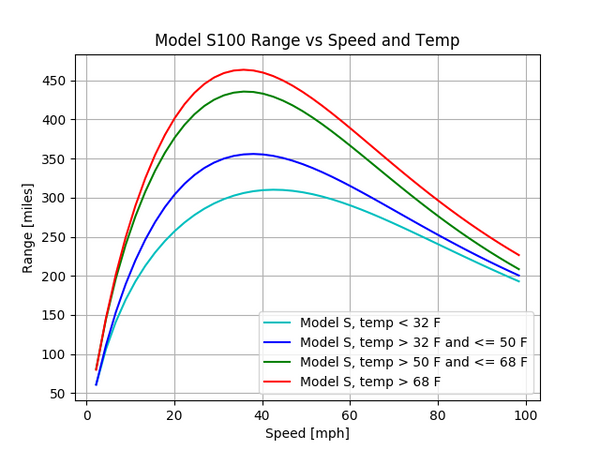
Since buying an EV I was surprised at just how much temperature affected range. Even in my Volvo C40 with a heat pump it's definitely noticeable. Here's an example range vs temperature graph for Tesla S100s showing as much as a 30% reduction in range in cold temperatures. It's a similar graph for every EV: https://cdn.shopify.com/s/files/1/0196/5170/files/model_s100...
This article is about a specific problem which is you can't even charge the battery if it's cold enough. That seems like a pretty terrible failure mode that needs a solution.
The general range problem is simpler. Partly it's because the battery chemistry works less efficiently when it's cold. And partly it's because some of the battery is being diverted to heat the cabin. (Another surprise owning an EV; they're hard to heat! No big engine throwing off waste heat. It's no accident most high end EVs have resistive seat heaters.)
One of the reasons I don't have an EV is I don't live in California and don't want to be a beta-tester while Californians, like Columbus, discover the rest of the world.
Yes, it's just that with diesels it's a known problem with a known solution. With all the new EV drivers and limited supercharger infrastructure, people are newly discovering it and it's harder to fix.
In may really cold places in the world they just leave the engine running so it never has time to actually freeze through and keep all the stuff moving.
I had the battery in my ICE car freeze in lower temperatures, and become damaged and stop starting reliably. I had to get it replaced. the only way to keep the car from damage was to keep a block heater running (from AC power) the entire time or store it somewhere warm which not all people have the option of.
Turns out extreme cold is bad.
Also this guy was driving something like 1100 km in -40 weather already - if you dont absolutely have to you shouldnt do it at all.
It's straight out physical chemistry. Chemical reaction speeds are temperature dependent.
The rule of thumb is that for every 10 degrees celsius increase, chemical reactions double in speed. (Conversely, drop that temperature by 10 degrees and the speed of your chemical reaction will be halved.)
In other words, drop the temperature of that battery by 20 degrees celsius and you quarter the amount of energy you can obtain per unit of time.
I think the problem is economics. Electric charging stations already have less ability to service as many customers per hour as gas stations. Requiring that they also provide a heated building for the cars to charge in would make it even more expensive. The upcharge for such costs would make the power more expensive and the business less competitive.
I think when the engine, in some circumstances, can bypass all the EV stuff and directly drive the transmission (parallel ev system) its more efficient (maybe that happens under heavy load, like highway driving, or accelerating). It uses a mechanism I think is called something like a power split device. The serial ev system, which is basically a tesla with a portable gas generator in the trunk, is less efficient because the engine power always goes through the electric motor, rather than sometimes directly driving the transmission.
It's easy to think that "up north" means the problems EVs sometimes have with Minnesota, or Ontario.
Not necessarily. We recently had a customer from the Yukon region in Canada. That customer is farther north of Saint Paul, Minnesota, than Saint Paul is north of Dallas, TX.
it's currently 13°F in Dallas right now, so not really sure the point of calling out specific cities. it's winter. it gets cold in winter. things have problems working correctly in that cold of winter.
your example of someone that lives so far north that their coming hundreds of miles south still means they are further north than most people is proving what? nice story and all, but the point is a bit lost
> it's currently 13°F in Dallas right now, so not really sure the point of calling out specific cities. it's winter. it gets cold in winter. things have problems working correctly in that cold of winter.
Only in Texas do things have trouble working correctly when it gets down to 13F. Auto-spec parts are rated for -40C to +105C.
Generally in Minnesota the primary problem with (older) ICE vehicles where the battery is located toward the headlights instead of back toward the firewall is that a battery with low charge will have a cell or two freeze when it's kept outside on a -10F - 30F night facing into the northwest wind, then the engine doesn't start the following morning and the battery needs to be replaced. Very few vehicles have trouble in 13F weather, except maybe in Buffalo, NY when so much lake-effect snow falls that the vehicle can't even drive through it.
I'm sorry, but one anecdotal story of an edge case is never a convincing argument to me whether pro or con something I'm looking into. It's essentially one of those "nice story, bro" situations that will be told over a pint, but not the thing that makes the decision.
EV industry is ripe for disruption. New startup could introduce "mobile charging station", a diesel generator on a trailer. And some hackers could modify EV firmware to charge while driving.
Next iteration could skip batteries and plug electomotors directly into generator.
Some "supercharging" stations are powered by diesel generators. So this is not a joke!
Or maybe some sort of swappable unit for a car, it could contain batteries or small generator. At week I would drive at city on electricity, for holiday trips I would swap power unit for petrol!
One that doesn't have ABS at all, though an alternator or charging issue can effect abs because abs relies on high pressure pumps that are powered electrically
There's a "bug" in older Accords that when voltage is low [like starting on a low battery] the camshaft position sensor sends ECU into limp mode that sometimes can only be cleared with dealer scanner (or or the Chinese knock off that you have to buy manufacturer specific profile.)
Limp mode is one thing, disabling ABS just because no battery, even if alternator is putting out current, seems like a design flaw.
> In Canada, Mark Bohaichuk made a widely read observation on hellsite X after meeting a Tesla driver stranded in -45°C (-49°F):
On X (formerly Twitter), conspiracy theories go around that journalists are out to get X because X is taking away readers and advertiser revenue. I'm not sure whether I believe that fully, but I do find it surprising that The Register calls X a "hellsite". Where has journalistic objectivity gone?
Work, usually. It's not uncommon for it to dip to the -40s for a few weeks in some parts of Canada. Your employer is not going to let you stay home just because it's cold.
I used to have a job that would require us to travel in extreme cold in remote areas of canada. We would go in teams of 2 - each one driving a different truck (in case one broke down) with a huge extra gas tank in the bed, some cold weather survival gear, and a radio for talking between the trucks.
If you have to drive 1100 km in -40 for work and they don't provide you proper transportation, you should refuse or you should rent a non electric car. It's literally a danger to your life to do otherwise.
If there is any wind at those low temps, the outside is a genuine danger to your health. In northern Maine where I grew up, we had to shut the schools for cold snaps a few times, because asking kids to wait for the bus in those situations is asking for children to freeze to death
> On X (formerly Twitter), conspiracy theories go around that journalists are out to get X because X is taking away readers and advertiser revenue. I'm not sure whether I believe that fully, but I do find it surprising that The Register calls X a "hellsite". Where has journalistic objectivity gone?
Twitter users have been affectionately calling Twitter "the hellsite" since long before the ascension of Naughty Old Mr Car. I think it may be via Tumblr, which was sometimes called that even earlier.
Per Google Trends usage of the term peaks, in the recent past, in late 2022 (I suspect due to people eulogising Twitter), and declines thereafter.


Plug-in hybrids are the perfect car for most people - I won't repeat myself but a previous post on the topic: https://news.ycombinator.com/item?id=38863491
Literally none of the problems pointed out in this article apply to people with plugins, and you still get 95% of the benefit of having an EV.