> Well, according to www.opensecrets.org, oil, gas and coal companies donated at least $43,000 to Zincke’s campaign. That’s more than 10 percent of Ryan Zincke’s total contributions from Political Action Committees.
I don’t understand. You think a pro-coal industry position is, what, unpopular with voters in Montana?
Your interpretation of the facts seems to be based on the preconception that voters in Montana have an antagonistic relationship toward the coal industry in the state. Such that there would be a conflict and companies would have to lobby the elected representative to do something they want at the expense of what is constituents want. That’s not what’s happening. Montana voters know where the jobs come from. And in fact, polls show higher trust in corporations than the government: https://www.wsj.com/articles/more-trust-in-business-than-in-...
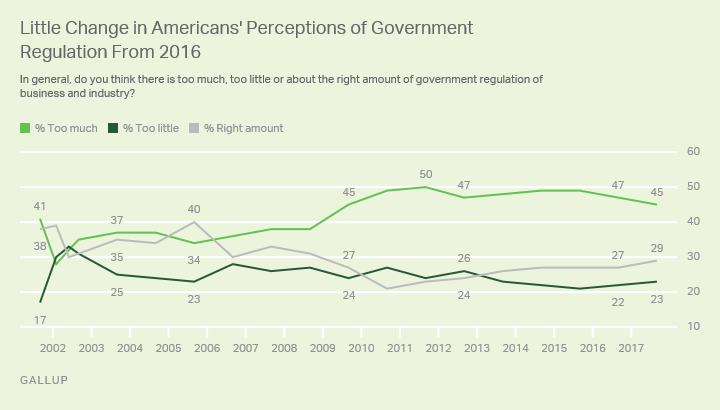
Read Gallup’s polling on the issue. Americans are incredibly suspicious of government and government regulation: https://content.gallup.com/origin/gallupinc/GallupSpaces/Pro.... Just 23% of people say there’s “too little” regulation of business. 45% say too much.
Now think about the $43,000 in lobbying, except assuming that voters in Montana want what’s best for the coal companies in their state. In that view, it makes more sense to understand that lobbying not as changing the vote, but coal companies communicating what they want to a politician that knows that his voters support giving coal companies what they want.
I really don't like the wording on the question for the
> Just 23% of people say there’s “too little” regulation of business. 45% say too much.
poll. Most people will pretty sanely say that pointless regulation is just anti-competitive so "broadly more regulation" is easy to be against. It'd be more difficult but I think some health or environmental specific policy would be better to poll about.
Many people in the UK voted for Brexit "to get rid of EU red tape", but when questioned were unable to name a single specific regulation they wanted to get rid of. Now UK businesses are swamped in customs red tape that the EU was designed to remove within the internal market.
It's a result of years of being lied to by politicians with an anti-EU agenda. It's very similar.
This isn't all that unfamiliar in the US. There are many people against "Obamacare", but once you start actually polling on the individual pieces that it entails it turns out it is very popular.
There is a reason why despite two years of full Republican control they could not agree on the repeal they kept banging on about for the better part of eight years, and why repealing Obamacare was not really talked about in 2020 lest Democrats successfully bludgeon Republicans over taking away their constituents' health insurance.
Depends which "individual piece", especially whether it was on the side that "spent money" or correspondingly "raised taxes". The individual mandate polled as 43% "very unfavorable" and 20% "somewhat unfavorable". Perhaps that's why it was, in fact, repealed.
Parts of it have been repealed, sure, but what Republicans were calling for were a full scrapping of Obamacare (and replacement) including the parts that people liked, like the ban on denying coverage pre-existing conditions or charging those people more.
They backtracked on this after Democrats wielded this as a cudgel in the 2018 blue wave.
Hilariously in the US the ACA (Affordable Care Act) polls better than ObamaCare - there is a large portion of the population that has experienced the benefits of the ACA and support that act while also continuing to advocate for repealing ObamaCare.
It's interesting to compare this to, say, the UK, where political spending is capped at £30,000 per seat, presumably to stop elections from being pissing contests to see which companies can spend more on effective lobbying. https://www.bbc.com/news/election-2019-50170067
Google has so much trouble rolling out Fiber. Bloomberg spent hundreds of millions on an election to little effect. Meanwhile, the fossil fuel industry supposed managed to buy a politician for $43,000. That implies that money isn't really the way into politics, not that politicians are easy to buy. Otherwise, it would be much more effective to spend money on politicians than million-dollar super-bowl ads.
> That implies that money isn't really the way into politics, not that politicians are easy to buy.
I don't think they are so hard to buy, but the currency you need isn't $. It's votes. $ are only useful in so far as they are means of getting votes. The $ you give them doesn't go into their pockets, or at least not in places discovering a bribe means someone ends up in jail. So what it is used for? The only use I can see is to earn more votes, by advertising, databases of voters, party machines and the like.
Votes can be delivered in other ways. The media can choose to spin it's stories one way or the other, which gives them an inordinate amount of leverage. In a state that employs a lot of people in coal mining, an employer intimating "if you vote for X, you get to keep your job" can have much more sway that a measly $43k.
Google's problem is they are a capital intensive, high wage, and consequently employ bugger all people for each $ they turn over compared to low wage enterprises that employ a lot of minimum wage people. Also they don't editorialise, and they don't advertise, and they are geographically dispersed. If a coal mining corporation swings the votes of 1,000 employees they could change the outcome of an election, but Google, despite employing vastly more than 1,000 can't do that. That leaves two options - lobbying and $ donations, which as you observe aren't that effective.
What has just transpired in Australia is an excellent example of what happens when Google does find the will to flex some real political muscle. I wrote about it here [0], but put briefly the newspapers decided to use their waning political muscle to get the Australian politicians to force Google hand over money from the ad revenue they generate from search. The pretext was very weak, so weak they could not define the sorts of activities the newspapers must be paid for so the proposed legislation literally named Google and Facebook, and demand they hand over $ to the newspapers. Capitalist cronyism at it's best.
I guess the newspapers thought they could deliver votes and Google couldn't. The politicians definitely thought so, as they floated a draft bill and it was at it's second reading. But it crossed some line for Google, the line that normally stops them from editorialising on their digital properties. They publicly threatened to shut down search in Australia and ensured it was broadcasted on every news channel in Australia, they put a 1/2 page banner on they search page (something most Australians see at least once a day) saying the same thing. Australian's read the sub-text: all your gmail.com accounts and emails, all your Google contacts, all your Android photos and a whole lot else besides is under threat.
Or at least that's my reading of what happened. In any case last Friday which was only a few days after that, the Prime Minister announced Google was being much more reasonable. As far as I could tell, Google's position hadn't changed at all from 6 months ago and they hadn't donated a single extra $, but they had just demonstrated they could shift a lot of votes.
No, it really is easy, compared to buying a distributed government. Single points of failure, we call them. From an attacker's perspective a single point of failure is an efficiency waiting to be exploited.