My wife gave me my Christmas present (a telescope) a little early this year so that I could practice and hopefully be ready for this event. I've had a few sessions already and it feels really special out in the cold night looking up at Mars and other planets whiz by. It does need some preparation though. I've got my site on a hill selected with no obstructions, the telescope has been collimated (calibrated), red dot finder is alligned, I've learnt how to setup the equatorial mount and polar align it, and I have my blue filter for clearer visuals of Saturn and Jupiter. Meanwhile I'm out in the back garden checking for clear skies any chance I get.
One thing to know though, you won't see the planets as they often appear in pictures, those are usually made from hundreds of long exposure shots stacked and processed to bring out the detail. You pretty much just see small bright spots in the sky with a little surface detail if your optics are good enough. There is something about seeing far away planets with your own eyes however which feels magic and photos can't compare to the experience.
Sounds like you've made a good start, if you're a first time scope owner. Even a modest telescope can provide you views of the solar system as well as deep sky objects that can take your breath away. If I could, a couple suggestions that can enhance your enjoyment of your scope as you become familiar with it and the sky.
First, keep a log of each viewing session. Note time and date, location, sky conditions, what you viewed. If you're so inclined, make sketches of what you see. Its nice, later on, to have a record of what you've look at and how it may have changed when you go back to it.
Second, find a local astronomy club you feel comfortable with. Most people will go out of their way to help a newbie. Attend any star parties that they may hold. They're great ways to see how others work and to see what other types of scopes can do. You will also learn how to better use what you have.
In any case, enjoy your scope. They can be great fun and they really bring home how wonderous the skies are.
Whilst on holiday in Tonga, I met an amateur astronomer with a decent telescope. I think he said it was "20cm". He was showing anyone interested Jupiter and Saturn, which I remember appearing about outstretched-finger-width.
Later, we somehow attached my camera to the telescope -- it must have just screwed on to the front, as you would attach a filter, since it's not a DSLR with a removable lens. It does have an excessively long zoom (600mm, it's a Sony RX10 Mk IV).
It took some fiddling to get the two devices to work together. We had to realign the telescope by finding stars on the camera's screen, work out where to manually focus the camera, and what settings (noise reduction etc, as well as ISO, aperture, shutter speed and so on) to use.
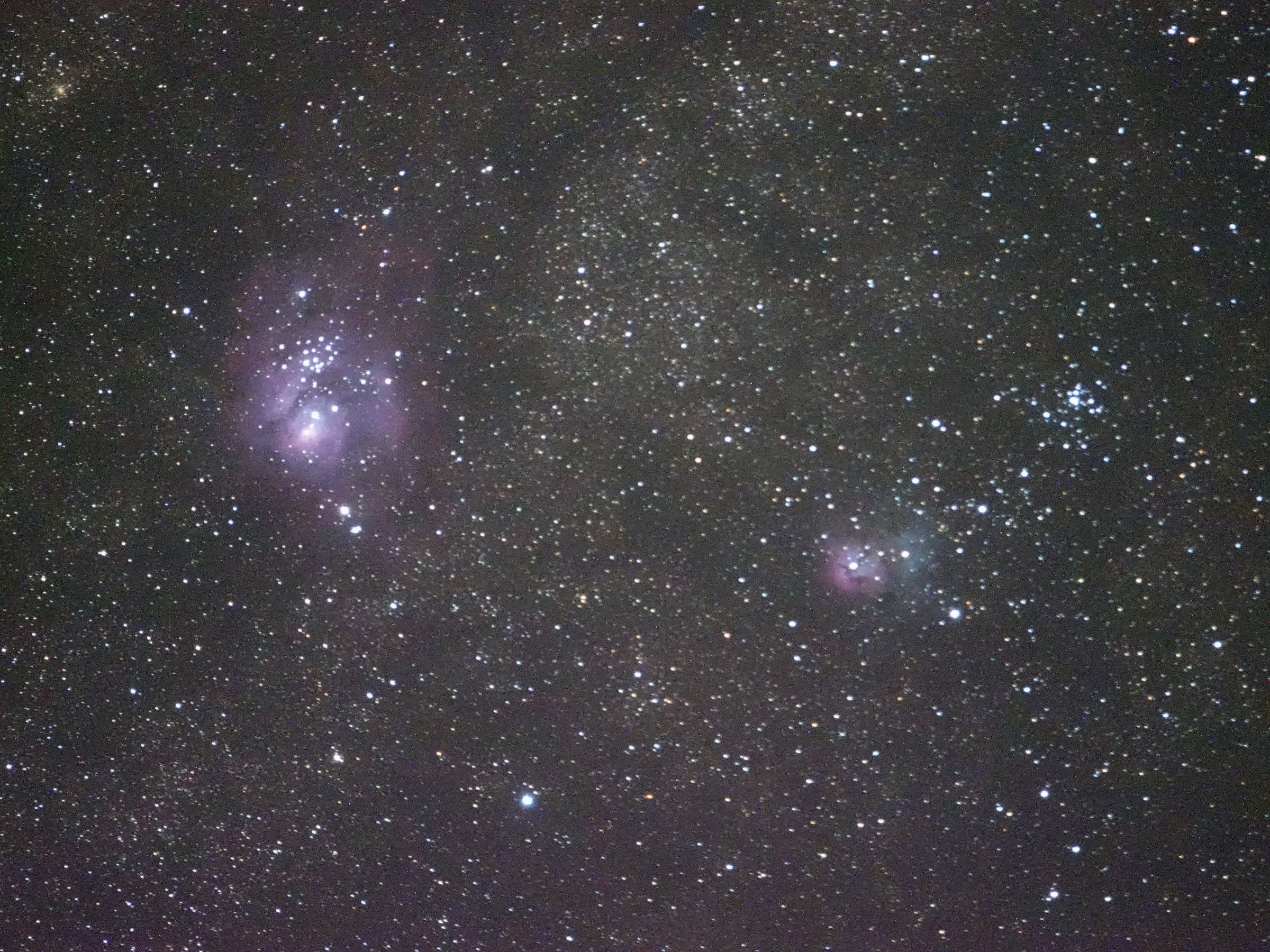
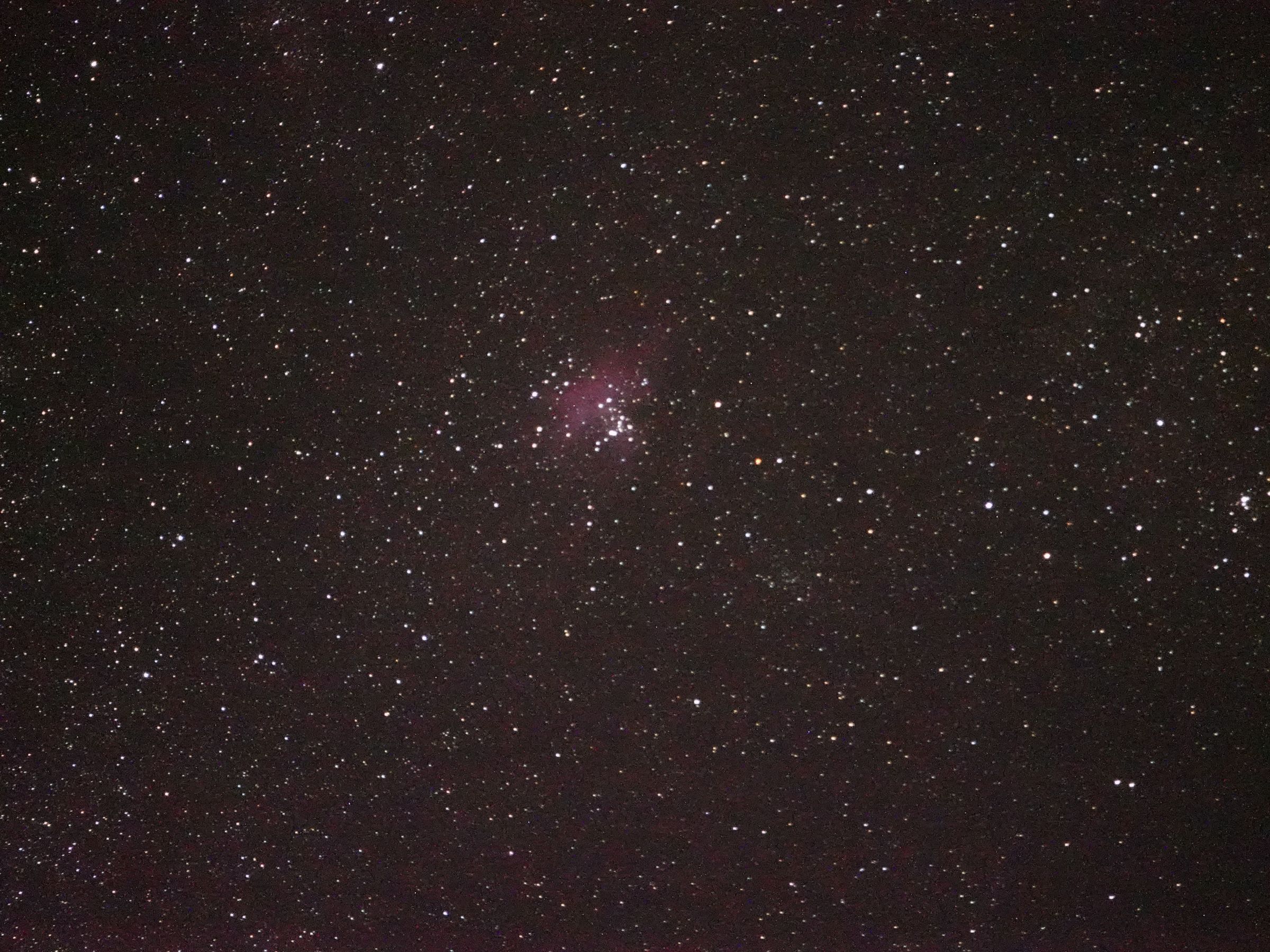
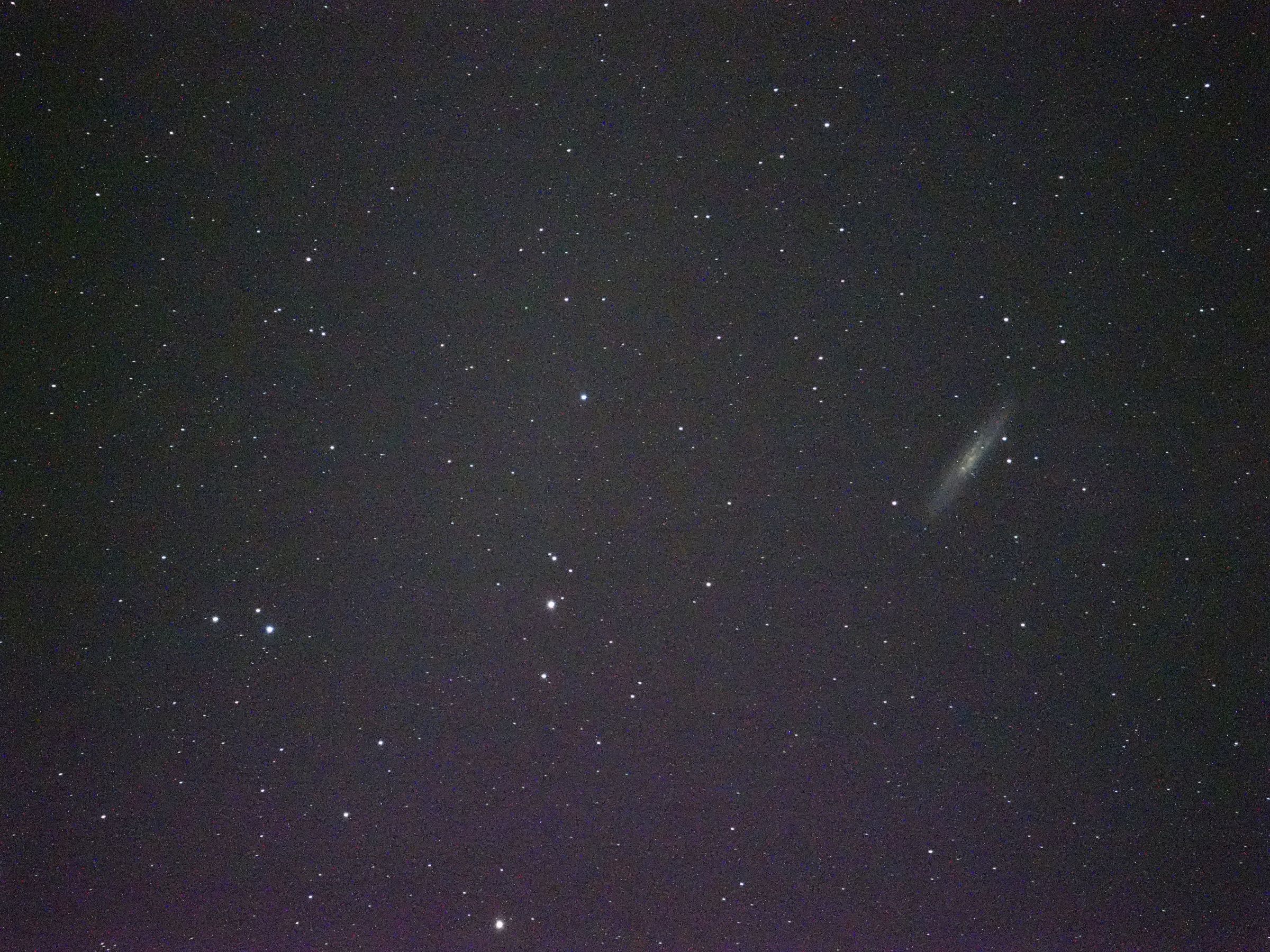
Combined, we were able to take these photographs of some nebulae[2-3] and a galaxy[4]. I don't remember, but I think the point was that these were not visible just by looking through the telescope.
It's a reasonably expensive camera, but gave noticeably better results than the astronomer's own Canon EOS 760D. If you don't have something similar, try borrowing a friend who likes wildlife / bird / sport photography or similar.
(All are 30s exposures at f4 with ISO 8000. Remove the ?w=2400&h=1800 if you want to see the original size. If someone recognizes the nebulae and galaxies, please let me know what they are -- I lost the notes I took at the time.)
Very nice pictures. I replaced my old DSLR with a mirrorless Canon M50. I did get a T-Ring adapter to fit it to the scope in the future so I will definitely be giving that a go. As you say, some objects can't really be seen with a standard telescope whereas a camera with long exposure can soak in the light. In fact you don't even need a telescope for many of them, a 200mm quality lens will do fine from the pictures I've seen.
Very nice pics! One can also start out without spending much money by using a holder/adapter with a smartphone that has a decent camera. Night mode or astro mode is the minimum to make it useful. I think stacking can be done using video and post-editing if the camera app doesn't allow long exposures.
I got to play around with a very simple telescope since being a child, which is still around in my parents house - never enough to see much of the planets, so this was always a bit disapointing. But what was and is always stunning, are the details of the moon ... (you need a filter, though).
You can see the shades of the crates moving for example.
Oh - and sunspots. Meaning you turn your telescope around and project the picture of the sun.
But one day soon, I am going to order a real one.
(But I also always wanted to have my own observatory.
And I guess, if I have that, .. I can't wait for my own space based telescope. Ah yes, the greed ..)
I bought myself my first scope this summer and have been watching both Saturn, juipter and now mars on occasion as they've precessed across the evening sky. Same feelings for me, it's magical to observe first hand with analogue optics and eyeball these planets :)
According to ancient scripture, "when the three planets are in eclipse, a black hole like a door is open, evil comes, spreading terror and chaos". The archaeologist working on this back in 1914 estimated this would happen every five thousand years (if his assumptions for the signs representing "1" and "5" were correct).
Fortunately, this isn't expected to happen until 2263. Still, in a 2020 full of surprises, having alignment of two out of three planets is too close for comfort.
(just to make this perfectly green: no, this comment is not supposed to be taken seriously)
Slightly more seriously, it's interesting to note that, according to Wikipedia[0]:
> When studying the great conjunction of 1603, Johannes Kepler thought that the Star of Bethlehem might have been the occurrence of a great conjunction. ... A triple conjunction is a conjunction of Jupiter and Saturn at or near their opposition to the Sun. In this scenario, Jupiter and Saturn will occupy the same position in right ascension (or ecliptic longitude) on three occasions (due to apparent retrograde motion) over a period of a few months.
Presumably the significance of a triple conjunction is that it explains the story of the Magi seeing a "star in the East", which then "troubled" Jerusalem when they arrived there, until it "went before them", and then finally "stood over where the young Child was".[1]
In addition to that, while Kepler was lecturing on the Great Conjunction he was drawing the trigon [1] which shows how the locations of Great Conjunctions change over time. This drawing (consisting of a triangle inscribed inside a circle that gets shifted over time), inspired him to pursue the idea that the distances to the planets were determined by polygons of different shapes inscribed in circles. This didn't work, so he moved on to Platonic solids, which worked better, but still not perfectly. Eventually this pursuit lead him to the idea of describing the planetary orbits by ellipses.
Not clear from the article if this is worth the effort of purchasing/setting up a telescope from rural SW England, but if any astronomers on can interpret how likely it would be to be visible under perfect conditions that would be really appreciated. Viewing this could be a great experience for a family over Christmas during the brief UK lockdown reprieve.
The planets will be just 10° over the horizon, so better make sure to have a look from the top of a hill. You can estimate an angle of 10° with the width of your fist while you arm is stretched out [1].
The planets will be visible in the south-west. You can look up a simulation of the scene in advance using Stellarium, a free astronomy simulation software [0]. Keep in mind that it does not show the local surroundings.
You need very good location with unobstructed view over western horizont. Some preparation and a bit of luck with weather. It is not a rocket science.
But get telescope in any case. Even cheap stuff from Lidl will show some details on saturn rings and cloud belts on jupiter. And there is also Moon and stars..
Take a look at https://skyandtelescope.org/wp-content/uploads/3-scopes.pdf for a good overview of 3 typical entry level suggestions. I have the Onesky (or rather it’s European sibling the Heritage 130P) and enjoy it. It doesn’t have any fancy features, but is easy to move around, doesn’t take up much storage space and still has plenty of power!
If you’re willing to spend some more, the Celestron NexStar 5 and 6 are solid telescopes that can automatically move to specific objects in the sky (this is called GoTo) which is really nice if you want to focus more on viewing objects rather than finding them. They’re low on maintenance too and work well for showing others objects in the sky as they can keep whatever you look at centered in the eyepiece.
I am no expert, but when I got into star gazing I was desperate to get a 'good' telescope and ended up spending about £250 on a 'cheap' scope.
These have two main issues, one they are a pain to set up so that you can easily track with the rotation of the earth. 2 that when zoomed in close enough to see planets, they will cross your field of view so fast.
My brother lent me some nice 8x50 binoculars and I've got so much more use out of them, and so much easy to use.
So unless you are prepared to put some serious effort in, I'd grab some £50 binoculars (8 or 10x50 are best, don't get any higher magnification (the first number) or they are too hard to hold still, and do go muhh smaller in the lens size (second number) as you want to gather all that extra light for your eyes.
I wish I'd spent 200 quid in 2 pairs of good binoculars - but hey you live and learn!
The (wide) conjunction has been clearly visible with the naked eye for months now. I live in an area with very severe light pollution, and the planets and a few of the brightest stars are all you can see.
Is it worth getting a telescope? Probably not just for this. Cheaper scopes are disappointing and - unless you're doing astrophotography - non-disappointing scopes are ridiculously expensive.
But you can get a good view of Saturn and Jupiter's moons with basic binoculars on a tripod, and spending more will give a clearer view.
No need to spend a fortune - a couple of hundred pounds will do very nicely. You can also view other astronomical standards like the Pleiades, Andromeda, Orion, the craters on the Moon, and so on.
A $300 dobsonian isn't ridiculously expensive. The lenses though - the lenses are the most expensive part. My 10 inch dobsonian (which is roughly the size of a person) is an accessory for my precious lenses.
I have been watching the bright blob of Jupiter (UK) this winter and assumed that to the naked eye Saturn was just merged in there too close to seperate. Is this right or was one of the near by stars actually Saturn and I didn't realize? Thanks
I've also been enjoying the view from the UK (weather permitting). I don't have a telescope on hand, but realised this autumn that my camera -- nothing special, just a Panasonic bridge camera -- could clearly pick out the four main moons of Jupiter, so we could watch how they moved around the planet from night to night.
The moon's diameter is about 0.5°, same for the sun, give or take — think total or annular eclipses, they are very close in angular diameter, if not equal for all practical purposes.
At this moment, December 5, 2020 at 4:20 PM Eastern, Jupiter and Saturn are 1.74° apart. So about 3.5 moon diameters apart right now.
Estimating angles in the sky is very difficult. It's also subject to perception illusions, like the "Horizon Effect" in which the Sun and Moon appear larger that their 0.5° diameter when, in fact, there's no difference.
Some say this effect explains why your penis looks small when you gaze down at it. It's hard to judge, sometimes.
Aha the pale dot just diagonally top left of Jupiter must be Saturn then. From my skymap they appear to be touching so I assumed the seperate extra dot was m73 star. Now I know better. Much apreciated. Thank you for the reply.
https://en.wikipedia.org/wiki/Great_conjunction gives the exact time as 21 December 2020, 13:22:00 UTC, or 5:22 AM PST. In SF, the planets will set around 7:10 PM, the sun sets about 5pm. So if my best observation time will be around 5:30 or 6pm, seems like they will be at least as close if not better on the 20th as the 21st, right? And then even more so for HI, two hours later.



One thing to know though, you won't see the planets as they often appear in pictures, those are usually made from hundreds of long exposure shots stacked and processed to bring out the detail. You pretty much just see small bright spots in the sky with a little surface detail if your optics are good enough. There is something about seeing far away planets with your own eyes however which feels magic and photos can't compare to the experience.