There may have been more violence among various radical and extremist factions in American politics in the 70s but that doesn't mean that America was more divided politically over all. There wasn't nearly as much partisanship in the upper-echelons of power in 70s and I suspect that there was more consensus among people in more moderate circles. There also wasn't this huge epistemological divide running right through the middle of the country; people were generally working from a common understanding of reality. Not so, today.
The political class may have been unified, but perhaps because so many people didn't participate in politics. Many religious people stayed away or at least did not vote along religious lines, and other large segments were disenfranchised altogether. So the separations may have existed but simply did not play out in the political arena because politics was in the hands of a homogeneous group.
Most people simply weren't exposed to a very wide spectrum of beliefs. Mass media focused on hard news, and it was either local and/or controlled by a few groups.
The wider diversity of media that came later allowed more opportunity for people to 1) find a viewpoint they more closely identify with, and 2) become outraged about viewpoints vastly different than their own.
>There also wasn't this huge epistemological divide running right through the middle of the country; people were generally working from a common understanding of reality. Not so, today.
Everyone was watching the same network news and reading the same newspaper. Once niche news sources started to become widely available, everyone went to the news source that gave them the news how they wanted to hear it. Over time these news sources grew more and more polarized as they continued to cater to their specific niche audience (some sources are certainly more brazen and intentional with this approach, but it happens naturally if you aren't actively working to stop it). There is only so much polarization that can happen when we all agree on the same basic set of facts. But now we are all stuck in our own bubbles, only listen to news that reinforces our world view, and we continue to spiral further and further into polarization.
With online news and the rapid news cycles, we're living in how The Onion presented 'Live poll lets pundits pander in real time': https://www.youtube.com/watch?v=uFpK_r-jEXg
So true! In addition to your points, so many were even watching the same news program for one person - Walter Cronkite at CBS. Additionally, the newspapers were of high quality. Of course, there were editorials with opinion pieces, but the news articles generally were reported neutrally (or at least with overt bias).
>There also wasn't this huge epistemological divide running right through the middle of the country; people were generally working from a common understanding of reality.
This is mostly a myth. Conspiracy theories for example, often taken as an example today of how flimsy reality is, always had an immense impact on American politics. Many American presidents were committed believers of conspiracy theories, Nixon was openly paranoid, of course with an extremely political bent.
The absurdity of the cold war and its influence on division in politics and what is actually real or not is well documented in just about every film made in the era.
Insofar as American politics actually is more divided today I wouldn't even frame it as a bad thing. It's just the result of vastly different people wanting vastly different things and having significantly more opportunity to express it. This desire for consensus among moderates is just an expression of another age-old American tradition, fear of the upper-middle class of everything that is political.
Yes, 538 did a couple of articles about how polarization is no worse than ever, but what is unusual today is how strongly the polarization lines up with political parties.
It is now notable to find some ideological question for which e.g. 80+% of Republicans do not agree on. The Democrats were lagging a bit on this, but are catching up rapidly.
They do note that at least some of this is due to people leaving the parties, but a lot of it is also due to people aligning their beliefs more with the parties.
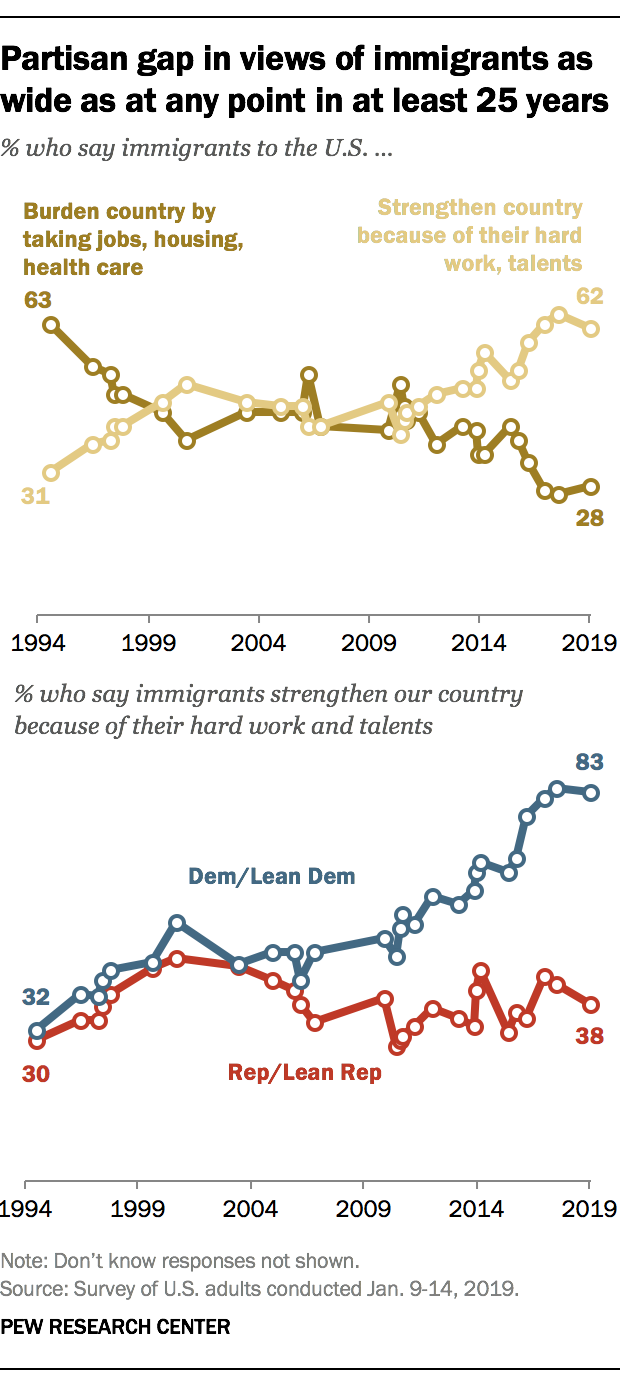
Look at the bottom graph here[1]. Note that up through 2004 both parties had roughly the same response to the question of immigrants. Then steadily those opposed to immigration within the Democratic party either switched to the Republican party or, aligned their beliefs with the pro-immigration stance.
Similarly for basically my entire life (born in 1980) the country has been split 60/40 on abortion. However, the democratic party used to be just slightly above average for pro-life with the Republican party below average. Now over 80% of Democrats are pro-life, and Republicans have polled in the mid 30s for over a decade now.
I think two other factors to consider are the rise of partisan media after the repeal of the Fairness doctrine and suburbanization, both making it easier for people to spend time mostly hearing voices they agree with.
One thing I find interesting about older novels is that it seems to be more common than now to know people that you disagreed with, perhaps strongly, but still respected. One factor in this is probably religion: church attendance has been dropping for a long time so there’s less social attendance and some of the most popular denominations became very politically active in the late 1970s so they rapidly became less diverse.
I think suburbanization has had a much larger impact than partisan media. Most Americans consume centrist media[1], but there are very few places now where there isn't a large majority of either left or right[2]. With the current political atmosphere, even if 15% of the population is the opposite of the majority, they probably aren't going to feel very comfortable being vocal about it.
You're probably on to something with religion. I'm Roman Catholic, and I remember a lot of Democrats being around at the church where I grew up, and obviously the Catholic church is a fairly conservative organization, and both of my parents are staunch Republicans (The 2 times they didn't vote republican in a national election were when my dad voted for Perot in '92 and my mom voted for Clinton in '16 (but straight republican down-ballot in both cases)).
I don't think they're that bold. The notion that congress is divided more strictly along sectarian lines today than the past is from this paper: https://journals.plos.org/plosone/article?id=10.1371/journal... which measures a decrease in cross-party voting over the last few generations.
The "common truth" is a bit more subjective, but I've definitely noticed people in my extended social groups having fewer and fewer information sources in common, as well as a smaller and smaller set of common beliefs. I'm not the only person I've come across who's had this impression.
There was nothing wrong with the parent comment. It would have been better to describe some of what's actually in the book, but it was still helpful information, obviously well-intended. I'm sure you didn't mean to bully js2 into deleting it, but please don't post like that to HN. There are kinder ways to ask for more information.
Oh, my apologies, I did not at all intend it to be taken like that.
I meant to say that while the book js2 linked is surely welcome information to have in this discussion, this doesn't absolve the OP of the burden to back the claims with something more substantial given how strong these claims are (and, as the thread shows, controversial).
Think America was divided in the 1970s? Try the 1860s.
And if you somehow think that the US Civil War doesn't count because it was soldiers fighting, remember that one of the precursors to the war occurred in Kansas. In the 1850s, civilians from both sides invaded and fought to kick the other side out so they could rig Kansas' vote on slavery. It was violence between civilians and obvious attempts to manipulate a democratic vote by both sides.
I'm not saying that the division now or in the 1970s is acceptable, but America's history (and that of many other "civilized" countries) is bathed in blood. Politicians win elections by having a "better" stance on the issues compared to their opponent. If they can make an issue divisive and considered a deal-breaker then they can keep supporters on their side, even if they are screwing their constituents on many smaller issues. This is why abortion is equated with premeditated murder on one side and complete forfeiture of a woman's autonomy on the other. This is why gun control is equated with supporting mass shootings on one side and the complete abandonment of freedom and the US Constitution on the other.
We should strive to be better, but realize that this isn't the worst it's ever been. It does seem like in the past couple decades, the increasing flood of information has made many aware of the divisions. Previously you could have lived you life in your community where most of the people think like you.
Exactly. I got downvoted for mentioning this elsewhere, but it has been noted over the last decade that modern political polarization is as bad in the 21st century as it was during the 1860's, which is opposite the thesis of this article.
The article mentions the US Civil War in it's third and second to last sentences in the last paragraph, and that's the only place. I expanded on that by a considerable amount.
Right now I feel like the Civil War is an apt comparison since we have state governors making pacts between themselves to act a certain way regardless of what the federal government says to do.
Sorry, I didn't mean to imply that you hadn't added anything interesting. I enjoyed those parts of your comment. It just sounded like you hadn't read the article, since you repeated its points as if they were new. I was trying to follow the site rule against saying "did you even read the article" (https://news.ycombinator.com/newsguidelines.html).
I don't get this article: it feels to me like a member of the older generation saying "I had to walk fifteen miles to school in the snow! Barefoot! Uphill! Both ways!".
To me it's a bit like whataboutmanship: "you think it's bad now? what about the 1970s, eh?".
Just because things were bad back then doesn't mean they're not _also bad_ now. Just because things are better it doesn't mean we shouldn't try to improve.
My reading of the article was that it sought to point out that how "bad" it is today isn't unusual or an anomaly. Today's divisions are more par for course in America than a new development. That perspective is relevant when we try to improve the current situation.
I can't claim to know how today compares to our past, but what strikes me about today is how close I feel we are in terms of values and ideas, yet how divided we are politically.
Without saying my political beliefs, I've had conversations about immigration, taxes, race, and religion with people both on and against my side of the aisle, with people of diverse backgrounds.
It's crazy to me how much we agree on and how minor our differences are, and how even those differences are seen through the lens of different means to a similar, just end.
Right up until the point that you start discussing political party or even specific politicians.
Then, it gets personal. Then, the very moral fiber of your being is up for questioning, commonality in goals or values be damned.
Yeah we can all probably agree on goals and outcomes.
My guess here is each person has an audience in mind and an applicability.
The dog whistle of saying the "American family" is being destroyed. To a conservative it means something about a god fearing hetero family. To a liberal it means anyone wanting to be in a consensual monogamous relationship.
Healthcare should be good and affordable. "For people like me." or "To everyone, even an illegal."
Could some of that be the difference between the principles that people advocate and how they act when the rubber meets the road? That is, it seems to me that most Republicans do not advocate anti-immigrant, racist, etc. opinions. However, when it comes to election day they are willing to vote in people who put those policies in place.
Indeed. I will judge you based on your effect on me. If the people you vote for are openly racist, homophobic, sexist, and paranoid, then as far as I am concerned you are racist, homophobic, sexist, and paranoid, and I will treat you accordingly.
I was young enough in the 70s not to get all of the subtlety, but I think we really are more divided now than back then. Current politics is vicious in a way now that I don't recall back then.
In any case, to get a taste of what things were like then, watch Ken Burns' excellent documentary on the Vietnam War (currently on Netflix?).
The whole article came across as "so what if the right has violent extremists who are ideologically supported by some of the highest levels of Republican leadership today... what about the ultra-left radical terrorists of the 1970s?!" This came as a surprise, until I realized that this article is featured in The Spectator.
The media (including social) has been nudging people towards these kinds of conclusions a lot. I remember seeing people associating black bloc protesters with Hillary Clinton which is a completely preposterous association. That is until you realize lumping them together might make someone scared AND mad giving them a lot more reason to not listen to many nuanced points.
Sometimes I feel like even if America had more upheaval in the past, it was at least the type of upheaval that could change things. Now I feel like people are angry and the system is setup such that there's nothing that they can do to change things.
I feel back then people were divided about topics. Now I feel the whole division is propagated by parties and people adjust their view on topics accordingly.
Gloria: Do you know that 60 percent of all deaths in America are caused by guns?
Archie Bunker: Would it make you feel any better if dey was pushed out of windows?
~
Archie Bunker: Well, I'll tell you one thing about President Nixon. He keeps Pat home. Which was where Roosevelt should have kept Eleanor. Instead he let her run around loose until one day she discovered the colored. We never knew they were there. She told them they were gettin' the short end of the stick and we been having trouble ever since.
Mike: Let me tell you something Mr. Bunker...
Archie Bunker: No, let me tell you something, Mr. Stivic. You are a meathead! A meathead, dead from head up! A meathead!
~
Archie Bunker: When your mother-in-law and me was goin' around together, it was two years — we never — I never — I mean absolutely nothin', not 'til the wedding night.
Edith Bunker: Yeah, and even then...
Gloria: I'm sorry, Mr. Davis, sometimes my father says the wrong things.
Sammy Davis Jr.: Yeah, I've noticed that.
Lionel Jefferson: But he's not a bad guy, Mr. Davis. I mean, like, he'd never burn a cross on your lawn.
Sammy Davis Jr.: No, but if he saw one burning, he's liable to toast a marshmallow on it.
~
Archie Bunker: Now, no prejudice intended, but I always check with the Bible on these here things. I think that, I mean if God had meant for us to be together he'd a put us together. But look what he done. He put you over in Africa, and put the rest of us in all the white countries.
Sammy Davis Jr.: Well, he must've told 'em where we were because somebody came and got us.
Violent, fringe, left-wing movements are of little importance because they have no corollary representation in electoral politics and are largely defunct. They’re likewise so far outside the neoliberal consensus of the Democratic Party that they have little hope of finding their way in.
The same, unfortunately, cannot be said for the right, which has a great deal of transit between milita groups, white supremacists, and the Republican political establishment. This is clear in Trump’s pardon of Amon Bundy, the dismantling of counterintelligence monitoring these groups’ activities, and in the rhetoric of politicians like Iowa representative Steve King.
I maybe wrong in thinking about this way, but in the 1970s people were debating over topics that were debatable. Vietnam for example, an argument can be made it was the right move to get involved. And, an argument can be made it was a mistake. Same with socialism vs. capitalism and a myriad of other large, complex topics.
Now the divide is around the basics of the scientific method. People think that vaccines have killed more people than they help. They think that hydrochloroquine is a wunderdrug and Bill Gates is suppressing its use so he can make more money. I see disagreements that are not arguable on any merit.
I pointed out to someone on social media the other day that the post they were sharing was objectively fake news (with links to proof). They responded that they didn't care because they believed it anyway. Is that a divide that can even be crossed?
Every topics is debatable, on the basis that no everyone think the same way, even scientific method. You would think mathematical statement such as 1+1=2 is obviously true, the absolute truth ? No, its still very much debatable, people can argue how to define '1','2','+', what axiom to use, etc.
This is exactly the point. What's happening today is that discussion of any topic of consequence is considered taboo. The main stream is largely shutting down debate by labeling people without ever actually addressing the claims made by those same people. If their claims are so ridiculous you should be able to make a cohesive argument against them without resorting to personal attacks or other logical fallacy arguments.
Doesn't make it different, so now we have feedback and people who aren't experts having a voice where fifty years ago people were vetted, from personal networks before they went live on TV and say anything.
> Now the divide is around the basics of the scientific method. People think that vaccines have killed more people than they help. They think that hydrochloroquine is a wunderdrug and Bill Gates is suppressing its use so he can make more money. I see disagreements that are not arguable on any merit.
The number of people who believe stuff like this is vanishingly small. They're just vocal in their ignorance.
I'd like to believe that. Is there any evidence to support the assertion that number of Americans that believe provable falsehoods is "vanishingly small"?
They're vocal because social media encourages them to be. They tweet out their crazy views and by dinnertime it's all over CNN and millions of people are suddenly listening to them.
24% of people choosing not to get a vaccine that doesn't even exist yet is significantly different from what was alleged in the parent comment, which was:
> People think that vaccines have killed more people than they help
A lot of people would choose not get a vaccine simply because they don't like needles, not because they think the vaccine is likely to kill them.
a) Today intense partisan divisiveness and animosity is felt by the overwhelming majority of the US electorate, not just among extremist groups with no formal political representation. Even taking the author's premise that the 70s had more bloodshed for granted, left-right animosity was comparatively low in conventional politics. A crucial factor of this was that the "realignment of the parties" had just begun with the Nixon administration, so there were still a great deal of centrist liberal Republicans and deeply conservative Democrats.
b) Unlike the 70s, extremist politics are represented at the highest levels of government. This is only true of the right, which is highly relevant!
c) Unlike the 70s, political extremism in the US is almost exclusively a right-wing phenomenon, both in government and in the general population. The few radical communists that actually exist in the US have little impact even on socialist discourse. The fact that Democrats have been moving left since 2005 is not at all symmetrical with the Republican plunge into proto-fascism starting in 2009. The lone gunman who attempted to kill Steve Scalise is not at all symmetrical with the masses who swarmed Charlottesville with anti-Semitic chants.
Of course given the source none of this is a surprise. The author rather gives the game away by focusing exclusively on socialist/marxist terrorism. Arsonists don't generally like taking credit for their work.
Extremism is on both wings. My Facebook feed is evidence, frinds who have nothing in common except they both know me are separetly posting their exaggerated anti trump left wing Memes. Same for the right wing except they are exaggerated of the pro trump memes
This article really misses the point. Sure, there may be times in the long past where there was a lot of divide. America once had legal slavery too. But it would still be absolutely appalling if slavery were to come back today.
The article almost gives off the impression that "oh it happened before so it's ok and normal". No, it's not ok and normal. It wasn't ok back then and it's not ok now.
Slavery is still legal in the US (it was never completely banned).
> The Thirteenth Amendment forbade slavery and involuntary servitude, “except as punishment for crime whereof the party shall have been duly convicted.“
There are about 2.1 million people in the prison system.
They’re forced to work, disproportionately african american, or other minorities. Many were wrongfully convicted. Their work props up a multi-billion dollar industry.
This doesn’t count refugees, who are also forced to work in US immigration camps.
But, yeah, to agree with your point, many people apparently think this is totally OK.
I pointed it out to my wife once, but the general look was that of disbelief. It was clearly internalized that this is how things should be. The prisoners are not slaves. They are prisoners. They have a debt to society and they better work it off. If anything, things are too easy on the prison population. It was an interesting revelation. I doubt this is an uncommon view.
Are they really forced though? My understanding is that working a job while incarcerated is something inmates who want lower sentences or just be out of their cell, besides how would you even force them? They can obviously just say no.
>But it would still be absolutely appalling if slavery were to come back today.
I've got news for you: undocumented labor makes up 9% of California's labor force [0]. Undocumented workers don't have the same exact conditions as slaves, but I'll leave the research to you as to why their position is one of extraordinary vulnerability and abuse at the hands of employers. People proudly tout California as the USA's largest agricultural exporter, but they don't acknowledge why it's possible.
Vulnerable to abuse as those workers are, that situation is not close to what was done to the slaves. You do undocumented workers a disservice by advocating their cause with so exaggerated a claim. I suggest reading https://www.montgomeryadvertiser.com/in-depth/news/2019/06/0.... It's hard to find the stomach even to read about. That was a whole different level of violence and brutality, and it doesn't minimize anybody's plight now to say so.
It's interesting that you find the the technicalities of my comparison more concerning than the actual modern day slavery taking place right under our noses. Rather than speak out for current victims being exploited right now, you are choosing to say "well it's not as bad as X". Take a step back and see how that is harmful.
I have seen several articles over the last decade comment that the modern American political landscape is the most polarized it has been since the U.S. Civil War in the 19th century.
Haves and have notes is a divide that has existed for nearly the entirety of human history. It's not usually what people are referring to when they talk about the extent of the American divide currently. It's really more in reference to the fact that republicans and democrats rarely cross the aisle to support something that the other side is supporting. In this sense, the American divide has gotten wider because it's much rarer to find a republican and democrat willing to agree on something than it was in the past.