This is the canary in the cage for those of who still live in something resembling a democracy. This kind of censorship, whether from governments or tech giants, is already starting to take hold in the US and Europe.
Maybe or 6-7 years ago now Reddit decided to remove some extremely objectionable subreddits such as those that sexualise minors, then shortly after that it took action to remove subreddits which had been deemed extremely offensive by some higher ups at the company. During these times I remember people both on here and on Reddit were extremely concerned. I remember that although most people didn't like these subreddits they felt these actions might spell the beginning of further restrictions to their speech on the platform - a platform which once believed strongly in the principles of freedom of speech. If I remember correctly there was even significant media attention and many Reddit users were so upset they attempted to boycott Reddit.
However now Reddit bans subreddits all the time. Twitter and Facebook delete the accounts of individuals at a whim, even they're publicly relevant or political candidates. And the sad thing is no one really cares any more. We just accept it as the new normal. Now if the media reports on it they often celebrate it. It was deserved they say, based of course solely on their subjective moral objections.
It's quite a balanced perspective, especially given the subreddit being banned in this case is /r/jailbait. I can't imagine anyone arguing that Reddit should allow that subreddit to exist today.
I suppose it surprises me how quickly perspectives have changed given we all now seem to accept private companies have the right to censor our legal speech online.
I personally don't like swearing, yet I don't believe others should be banned from swearing.
I don't like offensive subreddits like fatpeoplehate, but I don't think offensiveness should be banned. However, I understand that today I'm in a minority of individuals who believe people have the right to offend. I'm just not sure what changed, I know it wasn't always like this.
If anyone was too put out by Reddit's actions they could always start up their own site where they could sexualize minors or whatever else was dropped by Reddit.
2) Create laws to ban hate speech. This puts the government in charge of defining exactly what is and what is not hate speech.
3) The government tweaks the definition of hate speech slowly over the years. Eventually, hate speech includes anything which is against the official government line.
4) Profit. Err... Control of the country, which could be very profitable.
A bigger concern in the US is probably attempts to regulate "fake news". The US Constitution has strong protections for expressing opinions, even hateful ones so long as they don't promote imminent lawless action. Knowingly making false statements of fact has not been given anywhere near the same level of protection.
Any such regulation would be enforced by a part of the government that answers to the president. The current president has a habit of calling mainstream media outlets that are critical of him "fake news". Having to prove the truth of a large portion of the news stories published in a newspaper in court would be prohibitively expensive.
It isn't hate speech that should be the most concerning category. It is what they manage to brand as fake news or political in nature where they can then quash the message through campaign finance laws. When in office politicians have near unequaled ability to get their message out extreme care must be taken to insure they cannot prevent others from getting their own messages out
The one fact you can always accept is that if politicians are offering to protect the sanctity of the election system from influence, foreign or domestic, their true goal is to protect themselves from any message not approved by them or their supporters.
While some need to feel that the result is because of nefarious reasons we must always accept our views do not necessarily equal those of others and what we accept as truth and falsehoods can just as likely be incorrect as well if not just our bias seeking only confirmation in stories or others.
Even in a very pro "freedom of speech" country like the US, an executive-appointed Supreme Court is already responsible for ruling on existing laws against speech which is integral to illegal conduct, speech which incites imminent lawless action, and there exists a tort system which enables individuals to be financially penalised for certain types of speech.
Have no idea why people suspect that interpretations of hate speech laws are any more prone to being revised to be used to silence anything which is against the official government line than any other type of speech restriction.
The Citizens United case was about allowing filmmakers to incorporate to limit civil liability from Hillary Clinton’s legal team who tried to stop a film from being shown which was critical of her. This has become one of the most politicized Supreme Court cases and will likely be rolled back in the near future.
> 2) Create laws to ban hate speech. This puts the government in charge of defining exactly what is and what is not hate speech.
At least in the US, this is not possible without a change in the 1st Amendment. Hate speech is protected by the 1st Amendment.
While I am troubled by what I consider to be an attempt to expand the definitions of hate, ism, and phobia for political gain, freedom of speech entails allowing people to advocate for limiting freedom of speech. Also, I'm not sure why it is reasonable to say that China's actions are a canary in the coal mine for the US and Europe. These are different continents with very different histories and cultures. What happens in one is not necessarily going to happen in the other.
> At least in the US, this is not possible without a change in the 1st Amendment. Hate speech is protected by the 1st Amendment.
Right, which is why I'm personally mostly worried about service providers being wink-wink nudge-nudge deputized into performing a mostly-effective end run around legal protections on speech. Threaten regulation, accept a proposal to self-regulate (so we don't have to pass any laws directly forcing censorious action) and work from there.
If we're assuming that the goal is widespread manipulation of the political narrative, black-bagging dissidents isn't necessary to have a significant effect. Heck, this thread's Tiananmen example is the sort of thing that could be accomplished without any sort of overtly totalitarian stuff at all: you need a willing mouthpiece and an understanding with the folks running search results at Baidu that "not fake news from well-reputed outlets" gets bumped in the list. Consider how infrequently most users get past the first page of search results. I don't have stats, but I bet a similar thing is true just for whatever's the first result. Even if it's totally possible for someone to go off to another source and get their facts there, you've just rewritten history for everyone who didn't read past the top result.
I think this story is particularly interesting because it's an example of a method of government speech control and propaganda that, unlike many of China's heavy-handed measures, has a nonzero chance of being applicable in a Western democracy without being an overt violation of protections around political speech.
> Right, which is why I'm personally mostly worried about service providers being wink-wink nudge-nudge deputized into performing a mostly-effective end run around legal protections on speech.
This is totally within their right - in fact the 1st Amendment guarantees it. Freedom of speech isn't just freedom to say what you want, it's also freedom from compelled speech - freedom from the government saying "you have to say X, Y, and Z". To mandate that platforms host content isn't an "end run around legal protections on speech", their ability to refuse content is guaranteed by the legal protections on speech.
I assume you're talking about platforms here. Telecoms are utilities and are required to transmit content because they're government-backed. While I think there's a debate to be had about what parts of internet infrastructure should be regulated as utilities (I think hosting providers or at least domain providers should, they're filling a similar infrastructure role as ISPs in my view) it's incorrect to say that platforms' refusal to host certain content is circumventing freedom of speech.
> it's incorrect to say that platforms' refusal to host certain content is circumventing freedom of speech.
I think there's an argument to be made that this stance is incompatible with Marsh v. Alabama given the reach and impact of certain platforms, but I digress.
My real point was less that platforms should be mandated to host speech and more that extra-legal pressure from governments is a convenient method for suppressing or promoting information, especially when mechanisms for doing that within platforms already exist. These aren't incompatible- you could, for instance, really trust the moderation team of a particular platform and want them to be able to implement their moderation decisions (i.e not engage in compelled speech by being forced to not delete white supremacist content) while also not wanting those moderation decisions to be unduly influenced by government pressure.
It has always intrigued me that in the U.S. hate modifies the category of a crime.
It's one thing to assualt somebody; it's another thing to assault them out of hate.
It's one thing to kill somebody; it's another thing to kill them out of hate. If you can somehow prove that you didn't hate the person you intentionally killed, you face a lesser penalty.
Also, under fascism, speech may be protected in government contexts, but if the government turns over large swaths to corporations, and the corporations aren't required to protect speech, that's not the government's problem.
> Also, under fascism, speech may be protected in government contexts, but if the government turns over large swaths to corporations, and the corporations aren't required to protect speech, that's not the government's problem.
Corporations aren't required to host all speech, or be subject to any kind of government control in what speech they host (short of taking down illegal content like copyright violations and cse). In fact, requiring someone or a company to host speech is a violation of the 1st Amendment, because it is compelled speech. If you run a forum, and you ban someone for views you don't like the government can't step in and say "no, you're required to host this content". And legally, there's essentially no difference between your hypothetical forum and Facebook.
The only exceptions to this are utilities. An electric company can't just decide to stop doing business with someone that they don't like, since most customers have one choice for utilities. Laying electric wire, plumbing, etc. almost always requires approval from the government to in some sense utilities companies are indirect arms of the government. There's arguments to be made that hosting providers and domain name providers should be moved into this category. This would mean that a website can't be kicked off the internet as was the case with the DailyStormer for a while. But it seems like an extremely far fetched argument that sites like Facebook should be considered utilities.
It is a matter of the larger injured party as opposed to mere hate. Lets use Martians as a detached from real world context.
* If you crucify someone you are a depraved murderer who killed the victim.
* If you crucified say a martian over say how often they mowed their lawn it would be hatred related and psychopathic but not a hate crime.
* If you crucified a martian and wrote "Go back to Mars!" in their blood then you not only murdered them but also threatened the entire Martian community and that would be a hate crime. That is why it is a separate crime on top of it.
Countries such as Germany have banned certain kinds of hate speech (Holocaust denial, incitement to racial hatred, ...) for decades. There has been no slippery slope that this got more and more, it just has to be well defined and you need a serious judiciary and a healthy societal dialogue about what is and isn't acceptable. There is a far right party that everyone believes is pretty much the Nazi party, but it's not been banned as the evidence has not been strong enough. They didn't explicitly/provably violate any laws so they haven't been banned (yet).
That's a good, functional judicial process. It's a matter of professional judges and due process.
Well for one off the top of my head the terms climate change and global warming being scrubbed from government sites and reports politically altered or suppressed. Subtle but real. Steps in the wrong direction.
It is not really happening though. The most egregious case was the EPA "removing" some references. But bad as it was, they were only removing links from the home page, making the data less prominent. Reports and information on global warming were, and still are available on the EPA website.
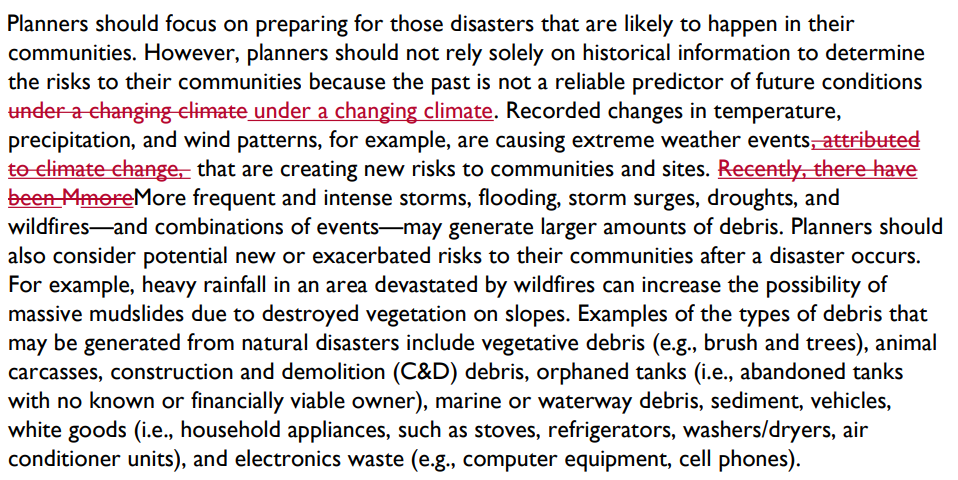
"In or around March 2019, the White House Office of Information and Regulatory Affairs (OIRA) removed several references to “climate change” from a guidance document on “planning for natural disaster debris.” The document was drafted by the Environmental Protection Agency and submitted to OIRA for review. During review, OIRA staff deleted several references to “climate change,” [snip]"
The EPA is a political office, run by a political appointee, so there will always be a political bias in what they choose to emphasize, and that's all that happened. Nothing was removed from public access, just moved from featured on the home page. If one admin put carbon tax on the home page, and the next replaced it with solar panels, is that suppressing the carbon tax?
The document you reference simply strikes out a single reference to there being a causal relationship between climate change and specific extreme weather events. The document is all about climate change, so it seems like a minor and likely accurate correction.
> The EPA is a political office, run by a political appointee
Well I'm a brit so I dunno, but from wikipedia "The Environmental Protection Agency (EPA) is an independent agency of the United States federal government for environmental protection"
> The document you reference simply strikes out a single reference to there being a causal relationship between climate change and specific extreme weather events
I've skimmed the document and I have to agree with you. I think it's a pretty vital point and perhaps should not have been deleted, but it appears you are right. So upvoted.
> Well I'm a brit so I dunno, but from wikipedia "The Environmental Protection Agency (EPA) is an independent agency of the United States federal government for environmental protection"
It gets complicated - it is considered independent because it doesn't directly roll up into a cabinet position under the president, but informally it is run like it is a cabinet position, the head is a political appointee of the president, and they can be removed by the president at will. So while more a grey area than something like the State Department, it is closer to that than more independent agencies Federal Reserve that acts without input from the Executive branch, and the appointees can't be fired by the president
Depends on the intent, if you go through every single website and agency and ensure that carbon tax is never mentioned by pre reviewing and screening them out, then yes. If its just one, then likely has nothing to do with support or lack of support, if its all and then there is a policy, then yes, obviously there is some intent and apparentness that you don't want it talked about.
I agree there is total intent. For example, imagine a environmental Republican who hates all taxes but wants to promote clean energy through solar/wind/nuclear. I'm just suggesting it isn't totalitarian, it isn't anti-science, and it is the prerogative of the President to have a wide latitude to promote different EPA policies.
Never said it was totalitarian. I suggested that the censorship was real even if it is subtle. I agree it's not totalitarian. Regardless, you can frame it how ever you want to make it more appealing to left leaning or pro green individuals, doesn't really change the argument just whether or not someone likes the result more.
The issue is, the government/current administration has used its influence to censor ideas and keep the public ill informed of the information of the matter. In this particular case arguably less damaging than China suppressing ideas around Tiananmen and definitely less overt and forceful, but still its happening, been happening really, as I said, more subtle but still in the wrong direction.
And before HN community boots up its strawman arguments (not you), no I'm not also talking about illegal, damaging, stolen, top secret material, etc. I'm talking about information and ideas that harm no and/or are required for the public to make informed decisions.
I'm not going to go through every example of agencies being told they can't use the term climate change on their twitter or every policy and action that has been done to undermine, something Trump does to everything he touches, the validity and efforts of the people behind climate science and education. But here are some PDFs and a articles that sum a lot of the stuff up.
Yesterday I did a search for "drunk pelosi" videos on duckduckgo and it reported "Sorry, no results here!" (Replacing "pelosi" any other name yields a page full.)
Today they have results -- properly vetted, I presume.
I think a smaller list would be where it isn't happening. mostly in small towns where independent journalism in independent newspapers still has an impact due to trusted local people working in them, although the death of print is rapidly quelling it.