I mean the AI companies probably just want to make American model pricing look ridiculous in comparison (it's working imo). I think the government probably wants actually-useful AI that could be put into chips and actually revolutionize factory work or mining or whatever. Large, SOTA models are not gonna change factory work but extremely efficient and optimized models may
Every industry-wide scale technological revolution has happened because government funded a technology and then opened it up to the masses. Just look at your iPhone: GPS, the internet, AI voice assistants, touchscreens, microprocessors, lithium-ion batteries, etc all came from gov't research (I'm counting Bell Labs' gov't mandated monopoly + research funding as gov't)
Economist Mariana Mazzucato wrote a great book about this called The Entrepreneurial State: Debunking Public vs. Private Sector Myths
> I mean the AI companies probably just want to make American model pricing look ridiculous in comparison (it's working imo)
I really don't think China cares about that. Chinese government's governance logic is making everything so cheap that everyone can get and use it. They did it with EVs and other things. Now they are doing it with the AI.
I like to feel that I'm spending my time productively, yeah. Not all of my time, mind you. People generally like to feel their work impacting their environment. Many consider it the most fulfilling part of their lives. Working purely for compensation is a great way to kill most positive energy for a solid half of your waking hours most days. People react differently, of course. For some the knowledge that they're making money alone provides the psychological reward, others find enjoyment in the moment-to-moment of things, even if they're not part of a meaningful goal, and yet others offset the meaninglessness of their work with a fulfilling home life or hobbies.
On the whole though, I'd say yes, people do care about productivity so long as they feel it's connected to their world and oriented in the right-ish direction.
I work remotely at companies until they fire me for doing the minimum. I still get paid for the two to three weeks, so I couldn't care less because the money goes towards my hobbies.
a good number do, I've been surprised by how many low level fast food managers actually care about how well the store's performing due to owner pressure despite seeing little to no wage improvement regardless
At college, one professor gave us a list of books we needed for class. All expensive, of course. Used copies were non-existent. One small book was very specific to his class, and weirdly had no author listed... unless you read the receipt. The author was the professor who recommended it. Self published too, and carried at the college bookstore. Total scam.
One lecturer at a Polytechnic I worked for made his students buy his book. Well, a photocopy actually, done without payment from him by the Poly's Copy Services.
Other lecturers got "gifts" from publishers for requiring or at least recommending the publisher's books.
The amount of corruption in higher education is quite astonishing - you only have to look at the prices of required/recommended books compared with actual good, classics to realise this.
I started studying at UNISA in the mid-90s. It was a distance learning university, with fees literally 1/10th that of a in-person university. They had more current students than all the rest of the SA universities combined.
Roughly half the textbooks required were published by UNISA press, with authors being the lecturers themselves. With one exception (Delphi programming), all the books published by UNISA press were free with the course.
It's astounding that +3 decades later, it is still not profitable for any other university to do this!
They were not so poorly paid - I was a senior analyst/programmer (and did some teaching), quite reasonably compensated, and the lecturers would get quite a bit more than me.
But if you want to substitute "established business model" for "corruption", go ahead. I must say that not all of them were bad.
When we had a book where only the homework problems changed in the new version we would pool together to buy one new copy and that person emailed out the homework questions.
The rest of us bought used books at the start of semester used book sale.
I think it worked best for everyone, I do wish I’d bought a few books new just for the longevity, but saving money was worth a lot more as a student.
When editions changed and problems were assigned from the books, most of the profs at my university would gladly provide copies of the updated questions. I even had a course where students would bring in photocopies of the prof's textbook to class, and he was still willing to pay a Knuth-esque stipend to students who found errors.
I had one that was the exact opposite, even going as far as violating the university policy by charging for quizzes. The administration refused to do anything about that one ...
I just went into the university bookstore & took photos of the question pages, lol. This was in the digital camera era, pre-smartphones, so it was hard to hide what I was doing and I got kicked out once or twice. Worth it to save hundreds of dollars.
Even better: optional book comes with a code you can use to register to an electronic version of the exam. Of course you can do it on pen and paper separate from most of the class if you don’t want to buy it…
Georgia Tech has/had its own publishing company. They actually encouraged their faculty to write books like this. I can't seem to find any information about it, but I swear it was there when I took classes in the late 1990s.
BMED2013 and it was still the same in my years. The culture has shifted a bit amongst professors though. After sophomore level classes I remember that professors will often just email you their textbook if you asked (a lot of times they’ll offer to “work it out”with you if you can’t afford the textbook).
I had one professor who did this but in the opposite way. On the first day he told everyone about the main book that would be used, one that he published. He sold it for the lowest price the bookstore allowed and encouraged anyone who couldn't afford it to copy someone else's or talk to him and he'd find a way to give it to them.
The only undergraduate class I had to repeat (because I failed its outdated-ness) was a 1hour lab for physical chemistry, which was taught by a geriatric whom still expected us to use decades-outdated "scientific software" [still DOS prompts, in mid-2000s?!?!] to perform calculations in support of since-disproven theories (mostly: his).
His class had a similar $$self$-$published$$ "book" [a packet of stapled 10lb paper] which hadn't been updated since his thesis, some sixty years earlier (literally 80+, now). Required turn-ins carried serialized imprints!
RIP when he died that summer and next year I retook the same class, with much more ease / better instruction.
----
Dr. Shithead's wife was actually responsible for my entire scholarship, sweet-as-pie, and we'd often joke about her husband's "reputation" – he's so gentle with me, but I know who he is.
> decades-outdated "scientific software" [still DOS prompts, in mid-2000s?!?!] to perform calculations in support of since-disproven theories (mostly: his).
Most computational chemistry is still done on the command line using decades old codes.
Gaussian is from the 70s, and it's still a major workhorse for small molecules. CP2K is from 2000 and is still popular for solid state.
It's actually a big barrier to entry in the field, because in addition to learning theory, you also have to know the Linux command line and whatnot
Around the same time, decades ago (and until recently), my father (a post-tension concrete expert, P.E.), was still using an early 1980s DOS program to design 8- & 9-figure government facilities.
I guess the span deflection/moment/&c calculations don't really change much (i.e. get fancy) on brutalist state buildings. But he did grow up hand-drafting blueprints (I remember the ink/smell from my childhood) and did have a regular 3D/CAD technologist for fancier designs (he despised architects' more-esoteric "Vision").
----
Wouldn't much of modern chemistry rapidly be integrating/upgrading within python environments (e.g. AlphaFold) on much-faster equipment? I know a few PhDs that are blown away by recent advances in dissertation-level output from machines — in days vs. entire graduate programs – and even walked the graduation stage with (now-Nobel Laureate) John, an Alphafold co-publisher... obviously his perspective is unique/polar.
I attended what was a top CS uni at the time. Many of the definitive textbooks were written by our lecturers when it came to specialised classes - which isn’t very surprising really! I would say most of them were just genuinely recommended the top textbook in the field. Just happened to be theirs!
Our lecturer for condensed matter physics based a large part of the course on an (excellent) book that was out of print [1]. He kindly had it photocopied and bound for us all for free.
College textbooks have always been a scam. 30 years ago when I took calculus 1-3 they tried to make us buy the next edition of the same book each semester! Even I, country-come-to-town bumpkin at the time, saw through that and refused.
To be fair, if I wrote a book it would be because I saw a gap in current books' coverage or quality. I don't think anyone chooses to be a professor for the money.
I had a professor who wrote his classes “books” and sold them for $100 at the bookstore. There was a catch though, he also gave away the pdf of the books for free.
This allowed for scholarships that cover the cost of books (typically athletic scholarships) to foot the bill, him pocket the money, and anyone not on scholarship can freely download/print the pdf.
I didn’t hate it.
Hah, that's not the norm? In my country it was. To be fair, the professors were required to give the students learning material in our native language and while some fields do contain other experts, the software field is different, so there was one book by that professor and that was it.
Most professors didn't mind how you got the material. But one of them... geez, every year he changed the content slightly and if you didn't have the latest one, he would write the test so that you would barely pass. The irony is that his lectures were really good and engaging but he really was a shitty person.
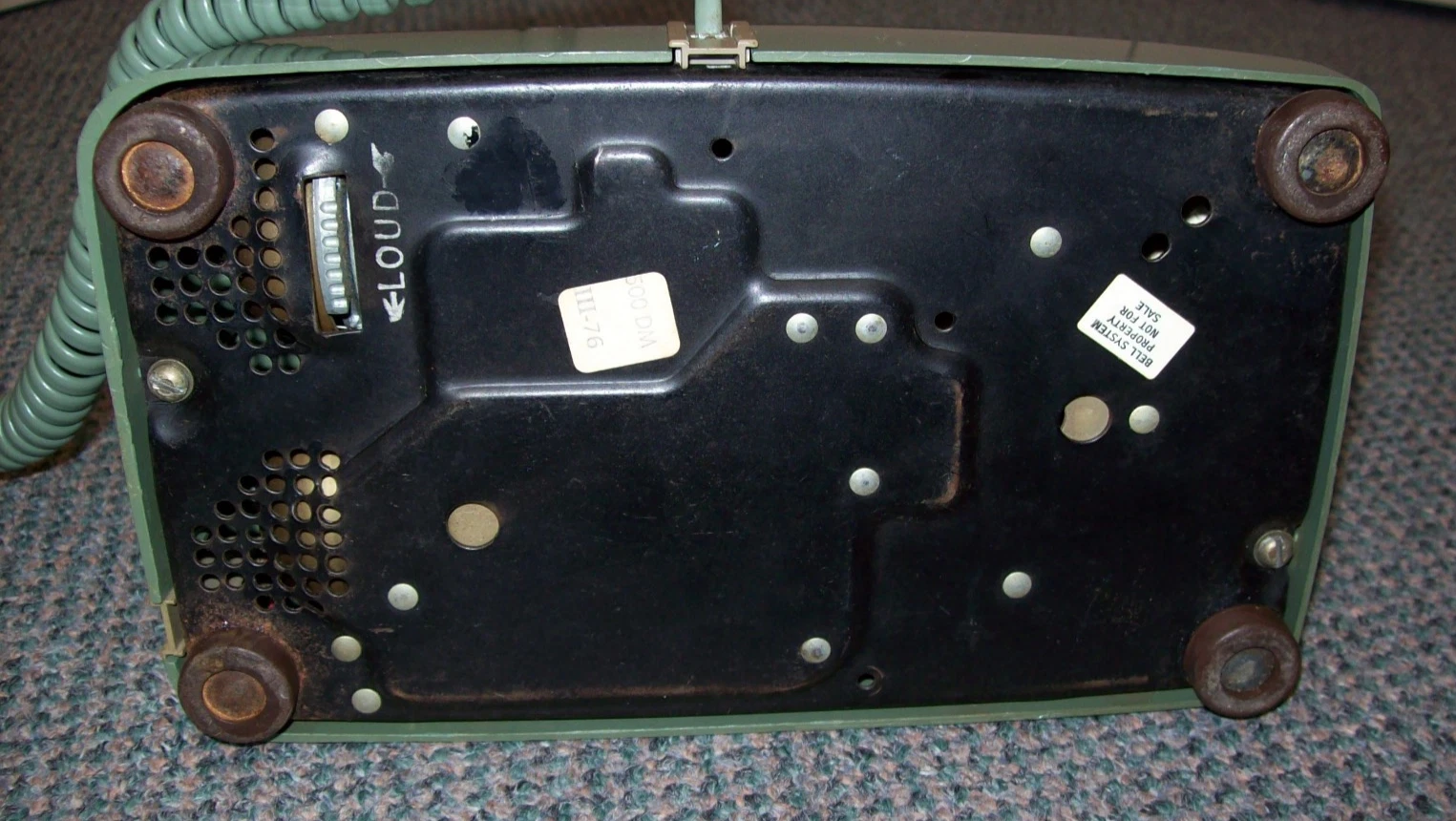
In the US, wired phones were often leased from the phone company! If you shop for vintage phones from the 1960s, they will often have a decal to that effect. Examples:
In 2008 I've got a Neo Freerunner, a few years later a Nokia N900, then a Librem 5. So at least the last 18 years, I guess? We need to work hard for it to keep going though.
(well, unless we start to bikeshed on the exact meaning of "fully control")
I wasn't alive in the 90s, so for me it was 2012-2015. Android was pretty open, iOS was easier to jailbreak, and the ecosystem felt a lot "freer" than today where you step outside of Google or Apple's garden and get endless Cloudflare captchas, apps refuse to load due to attestation, and things are designed without privacy in mind.
I am far from young, but I fail to see the appeal to this prelapsarian age when we controlled our devices.
In no uncertain ways, when things come to technogy things are so much better. Linux is awesome nowadays, self hosting is cheap and easy to get into, etc.
How exactly are things worse now in regards to controlling your own devices?
What are these pages? Are you just copying the text from articles and posting them independently? How do we know it's the same text as the original article? More common to use archive.today sites or IA Wayback Machine



reply